It's 7am, April 17. I just pushed the new multi-metric scorecard live — three new ways to judge any bot beyond just "total return." The first thing I do is run it against my own bots.
Three bots in the rotation family — Tactician, Rotator, Tri-Rotator — all trading momentum. The scorecard ranks them. Tactician finishes last. Not because it's bad, but because the two siblings cover similar ground and do it better.
I open the deployment file and start typing "retire Tactician" into the comment.
Then I stop. Because that's literally the mistake I just published an article warning readers not to make.
So Tactician 2.0 stays. Not because the data says it's the winner, but because retiring on backtest alone — before a single live trade — is exactly the trap our own methodology page exists to prevent.
Here's the bot, the awkward discovery, and the experiment that decides its fate in 45 days.
Status update (2026-04-17 evening): Live as paper-traded bot. We almost killed it the same morning we built it — the multi-metric panel showed two sibling bots clearly outperformed it. Then I caught myself doing exactly the thing we tell readers not to do: judging on backtest alone. Kept it live for a 45-day reality check. Story below.
The strategy in one sentence
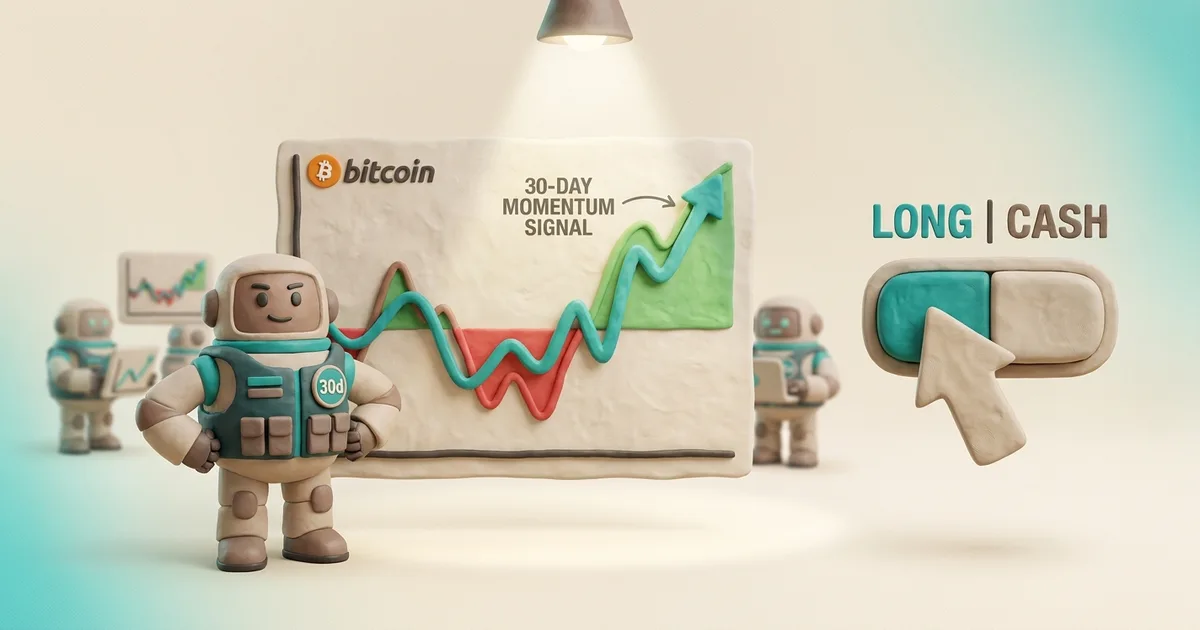
"Is Bitcoin's price higher today than 30 days ago? If yes, buy. If no, sit in cash. When Bitcoin is swinging wildly, shrink the position so one bad day doesn't wipe a quarter off the account."
That's it. One comparison, once a day, with one twist. When the market is calm, the bot goes all-in. When Bitcoin is wild with big daily swings, the bot dials down. Less exposure during storms, full exposure during calm trends.
This is The Tactician 2.0. Paper-traded with $10,000 virtual capital. Running daily.
The captain metaphor: Picture an old sea captain reading the weather from his ship's deck. Calm seas? Full sail, max speed. Storm clouds? Reef the sails, ride it out small. He doesn't try to predict where the storm is going — he just shrinks his exposure when the wind picks up. Tactician does the same with Bitcoin volatility. That's the whole strategy.
Where the "2.0" comes from
The first version was binary: 100% in BTC if the 30-day trend is up, 100% in cash otherwise. Black and white.
The 2.0 version adds one thing — the size of each buy depends on how wild the market has been recently. Why? Because Bitcoin's worst drawdowns happen during the wildest periods. If the bot is all-in when the daily swings explode, the drop is brutal. By shrinking positions when the market is nervous, the drawdowns shrink too — without killing the upside.
Numbers from the 8-year backtest:
| v1 (binary) | v2.0 (wild-market sizing) | |
|---|---|---|
| Total return | +959% | +1,126% |
| Max drawdown | -65% | -58% |
| Trades per year | ~38 | ~50 |
Better return AND shallower worst-loss. That's a strict upgrade, not a tradeoff.
Back to the captain: v1 was a captain who only had two settings — full sail or anchor. v2 added a middle gear — partial sail. Sounds small. Made the difference between losing two-thirds of the ship in a storm and losing only a half. Same principle.
The awkward discovery
The same morning I built v2.0, I shipped a new way of judging bots on this site — a multi-metric panel instead of just "total return." Benchmark Tunnel Vision explains why.
I applied the new panel to all our bots. The Tactician 2.0 finished last. Not because it's bad — because two siblings cover similar ground and do it better:
- The Rotator (BTC ↔ ETH switching) beat HODL in 3 of 3 historical periods. Tactician beat HODL in 2 of 3.
- The Tri-Rotator (BTC ↔ ETH ↔ SOL) beat HODL in 75% of any rolling 12-month window. Tactician beat HODL in 57% — barely above a coin flip.
Both rotation bots capture something Tactician structurally can't: they pivot across assets, so when one coin is strong they ride it, when another takes over they rotate. Tactician is stuck with BTC. On the multi-metric scorecard, that single-asset focus shows up.
So I sat with the multi-metric numbers for an hour and caught myself typing "retire Tactician" into the deployment log.
Remember: When your data tells you to act fast, that's exactly the moment to slow down. Half of the worst trading decisions ever made started with "the numbers were obvious."
Why I didn't pull the trigger
Two reasons, in order of weight.
First, that's literally the mistake we tell readers not to make. I had just published Live ≠ Backtest — an article about exactly this gap between backtest predictions and what actually happens when money moves. Retiring a bot purely on backtest data, before any live execution, would contradict the methodology I'd shipped 48 hours earlier. If I retire Tactician on backtest alone, why does the methodology page exist at all?
Second, the cost of keeping it live is basically zero. A cron job, a few seconds of CPU per check, an occasional Telegram message. The cost of not keeping it live is information loss: I'd never know if the backtest was right about Tactician underperforming. That's the exact question the methodology is designed to answer.
So the Tactician 2.0 stays paper-traded for 45 days as an explicit experiment.
The hypothesis: the backtest predicts this bot underperforms its rotation siblings. Live data will either confirm it (and we retire cleanly with an honest post-mortem) or contradict it (and we learn the backtest model missed something, and we update our thinking).
Either outcome teaches us something. Retiring on day one would have taught us nothing.
What "45-day reality check" looks like
Four momentum bots running in parallel right now:
- Tactician 2.0 — BTC alone, 30-day momentum, wild-market sizing
- Rotator — BTC ↔ ETH, 21-day momentum comparison
- Tri-Rotator — BTC ↔ ETH ↔ SOL, 30-day momentum
- Hedge Hopper — BTC ↔ Gold Miners, 40-day momentum
All four trade daily. All four get the same data, the same infrastructure, the same fee model. After 45 days I compare:
- Did each bot's live trades match what the backtest predicted?
- Did any bot surprise us, in either direction?
- Where did slippage, fees, or emotion produce gaps the backtest didn't model?
If Tactician 2.0's live performance falls 10-20 percentage points behind the rotation bots — the backtest was right. Retire cleanly and publish the post-mortem.
If it surprises us and stays competitive — the backtest model missed something. Back to the drawing board on the methodology, not the bot.
I'll publish the comparison openly so readers can audit the decision.
Like a fleet competing in real weather: Four captains. Same sea, same wind. Three say they'll ride the route faster than the binary "up or down" model. The fourth (Tactician) says "I'm worse on paper, but maybe paper isn't the whole picture." 45 days at sea. Then we read the actual logs.
Honest bounds on the strategy
The strategy class — single-asset BTC momentum — has a structural limit. In clean, sustained bull runs on BTC, just holding will usually beat any momentum bot on this asset. Every trade adds fees that HODL doesn't pay.
In sideways markets and bear phases, the trend filter and position-sizing rules earn their keep: they keep you out of the worst drawdowns and re-enter as the trend turns up. That's where the 500+ percentage points of backtest alpha over HODL came from — not from trading the bull markets better, but from sitting out the bear markets safer.
So what is this bot actually for?
Bottom line: Tactician 2.0 is for someone who can't sit through a -77% drawdown (HODL's worst) but can sit through -58% (the bot's worst). The captain who reefs his sails sleeps better than the captain who runs at full mast through every storm — even if he sometimes arrives a day later.
If you can ride HODL unblinkingly through every crash, you don't need Tactician.
What you'll see
- /bots page — live performance card with the multi-metric panel (Tactician is bot #6 in the lineup)
- Telegram alerts — notification when the bot rebalances (every few weeks on average)
- Day 45 (around 2026-06-01) — we publish the live-vs-backtest comparison and decide
If retired: post-mortem with all the numbers. If kept: explanation of what the backtest missed.
For Quants: raw metrics
- Strategy: 30-day momentum on BTCUSDT daily.
target_weight = min(1.0, 0.60 / realized_vol_30d_annualized)when momentum positive, 0 otherwise. Rebalance threshold 5% target-weight delta. - Backtest period: 2018-01-01 to 2026-04-17 (8.1 years, Binance daily, 0.10% taker fee)
- Total return: +1,126% (vs HODL +603%)
- Max drawdown: -58% (vs HODL -77%)
- Sharpe Ratio: 1.00
- Calmar (annualized): ~0.5 (modest)
- Walk-Forward: 2 of 3 windows beat HODL
- Rolling 12-month beat-rate: 57% (just above coin-flip)
- Rolling 6-month beat-rate: 50% (essentially coin-flip)
- Trades per year: ~50
- Average win/loss ratio: ~1.4
Comparison to siblings:
- Rotator: Sharpe 0.83, Walk-Forward 3/3, 12mo beat 58%
- Tri-Rotator: Sharpe 1.40, Walk-Forward 2/3, 12mo beat 75%
What do these terms mean? See the Methodology page.
Further reading: Live ≠ Backtest — why we keep predicted-losers running. · Benchmark Tunnel Vision — why one number isn't enough. · The Rotator — the cross-asset cousin Tactician is being compared against. · The Tri-Rotator — the 3-asset extension that leads the multi-metric panel today. · Meet The Surfer — our newest bot, also follows the "wait for the right moment" philosophy.
Validation Status — v2.1 (2026-04-28)
| Field | Value |
|---|---|
| Tier | Tier 2 — Simplified to binary v1 on 2026-04-27 (RP wrapper dropped) |
| v2.1 paths | Path 1 clears historic (67.5% all-eras) but recent fading (55%) |
| Walk-Forward beat-rate vs S&P | 67.5% all-eras (27/40); recent 2023-26: 55% (6/11), avg excess +7pp |
| Sharpe | 1.06 |
| Per-trade Win/Loss | 3.57:1 (✨ #2 in suite after Watchdog) |
| Multi-X | Vol-target wrapper proven non-additive (binary v1 beats RP-60% by +13,572pp) |
| Status | Paper-tracking under all-paper policy. State reset 2026-04-27. |
Honest caveat: Edge vs S&P is fading in the current regime (SPY rallying while BTC ranges). Per-trade W/L 3.57:1 is the saving grace.
Real-money eligibility: ≥6 months forward-validated proof required. First eligibility window: 2026-10-28. See /methodology for the full v2.1 multi-benchmark framework + Real-Money Graduation Criteria.