"What's your bot doing right now?"
A colleague asked me that last week. My answer:
"Nothing."
He looked at me confused. "Nothing? You've put real money in a trading bot and it's doing NOTHING?"
"Exactly," I said. "For 184 days."
Silence.
"And that's a good thing?"
"That's the BEST thing it can do."
Why am I telling you this? Because my colleague represents you. All of us. We expect action. Drama. New trades every day.
But the reality is brutally boring: The best crypto strategy does absolutely nothing 94% of the time.
In this article I'll show you:
- Why my bot has been sitting in cash since October (and Bitcoin dropped 36% anyway)
- How trend-following made +2'942% in 6 years vs HODL +644% in backtest
- And why "boring" is the best compliment for a strategy
Let's go.
The Surfer Metaphor
Imagine you're standing on the beach. Most people run into the water as soon as they see a small wave. They paddle around wildly. Fight the current. Go under.
The pro surfer? He sits on his board. Waits. And waits some more.
Why? Because he knows: You don't create waves. You ride them.
That's exactly how trend-following works: You wait for the big moves. Then you jump on. Ride along. And get off before the wave breaks.
Sounds simple? It is.
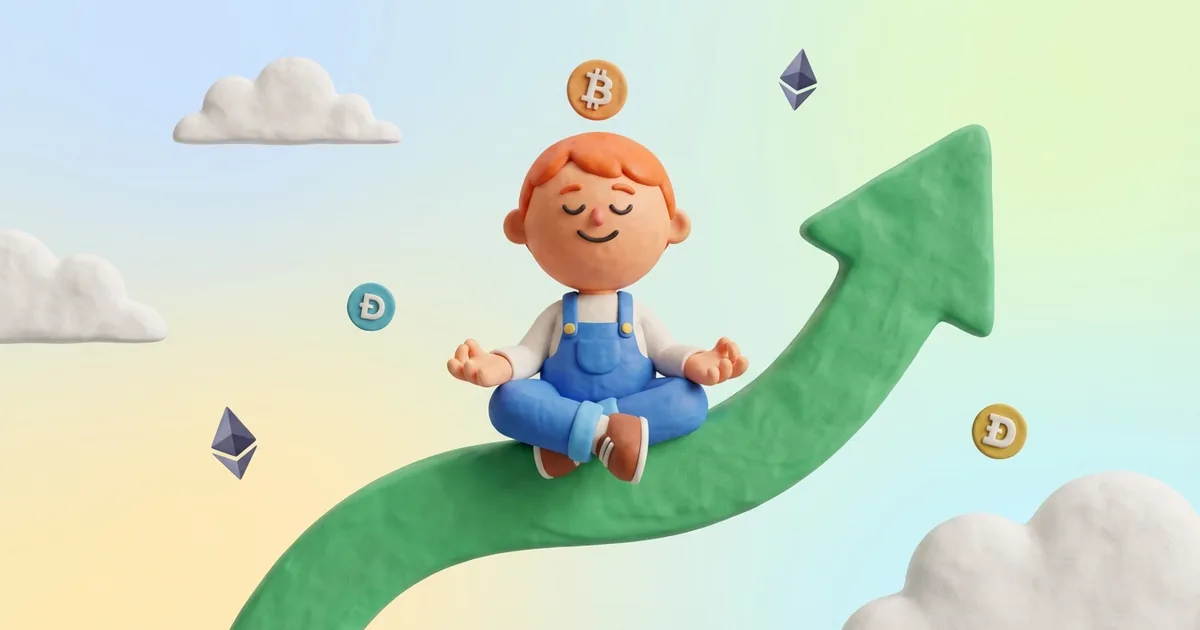
The whole strategy in one image: A pro surfer doesn't paddle every time the ocean ripples. He sits. He scans the horizon. When the right wave comes, he goes — fully committed. The rest of the time? He's chilling on the board, looking patient. People on the beach think he's lazy. He's not. He's waiting.
My Colleague Wasn't the First
Last month another trader asked me: "How often does your system trade?"
"About 4 times a year."
Pause.
"Only 4 times? That's nothing! My bot does 50 trades a week!"
I asked back: "How's it performing?"
Silence.
If you're one of those who believe more trades equals more profit, then let me show you the truth.
The Raw Numbers
My trend-following bot, in the wild right now:
- Since October 2024: Entirely in cash
- Bitcoin in that time: −36%
- Bot performance: 0% (but also not −36%)
The backtest over the last 6 years:
| Metric | Bot | HODL |
|---|---|---|
| Total return | +2'942% | +644% |
| Time invested in BTC | 60% | 100% |
| Time in cash | 40% | 0% |
| Trades per year | 4 | 1 (buy + hold forever) |
| Maximum drawdown | −35% | −77% |
Factor: 3× better than HODL with less than half the drawdown.
Honest context: The bulk of the +2'942% comes from explosive Bitcoin growth in those years. That won't repeat itself like that. What remains is the principle: the bot avoids the big crashes. And THAT principle works regardless of whether Bitcoin rises 300% or 30% per cycle.
In dollars: $10'000 invested 6 years ago. HODL: $74'400 (with a temporary drop to $17'100 along the way that nearly broke you). Bot: $304'200 (with worst drop to $65'000 — uncomfortable, not catastrophic).
See the problem with action-trading? While others were frantically trading back and forth, my bot sat calmly in cash and waited.
And waited.
And waited some more.
Remember: The art isn't in trading. It's in NOT trading. The pro surfer's most important skill is sitting still on the board.
How Trend-Following Actually Works
Forget everything you've heard about complicated indicators. Trend-following is based on one simple principle:
Buy when the trend points up. Sell when it points down.
My system uses multiple filters that measure the trend. When the filters say "up," it buys. When they say "down," it sells.
That's it.
No 47 indicators. No "revolutionary AI." No secret algorithms only insiders know.
A few clear rules. Done.
"But That's Way Too Simple!"
I can hear you saying that.
That's EXACTLY the problem. We think complicated = profitable.
The truth is the opposite: The simplest systems work best.
Why? Because less can break. A system with 2 rules has 2 failure points. A system with 47 rules has... well, 47.
Roger Federer also had only 4 basic strokes. Still won 20 Grand Slams.
Back to the surfer: He has one decision rule — "is this wave worth catching?" He doesn't run 47 calculations on the wind, the tide, the moon phase, the ocean temperature. One look. One decision. Go or don't go.
The 184-Day Story
Back to my colleague. He couldn't understand why my bot has done nothing for 184 days.
Here's the explanation:
October 17, 2024: Sell signal. Bitcoin at $67'800.
Since then: Cash.
Bitcoin today: $43'200.
That's −36% my bot DIDN'T participate in.
While others "bought the dip." And the dip after that. And the dip after the dip.
My bot? Sat calmly in cash and waited for the next buy signal.
What was happening on the beach those 184 days: Other traders were paddling out into every small ripple. Buying. Selling. Hoping. Some made small wins. Most got crushed by the slow grind down. My bot didn't take a single ride. And ended up further ahead than anyone who tried to time the chop.
That's Why It Works
Trend-following protects you from the biggest danger in crypto trading: Yourself.
You think you can catch the bottom. You think "this time it's different." You believe in stories instead of data.
The system believes in nothing. It stubbornly follows its rules.
Trend up? In. Trend down? Out.
No emotions. No hope. No fear.
Remember: The system isn't smarter than you. It's just more disciplined. Every successful trader I've met says the same thing: their hardest enemy was the person in the mirror.
The 60/40 Rule
Here's the beautiful part: My system is invested in Bitcoin 60% of the time. 40% in cash.
That means: You catch 60% of all upward moves. But also only 40% of all downward moves.
Mathematically: An unfair advantage.
In bull markets you're in. In bear markets you watch from the sideline.
Like surfing: You ride the big waves. You ignore the small ones.
"But I'm Missing Opportunities!"
The biggest misconception about trend-following: "You miss the entry!"
True. You never buy at the absolute bottom. You never sell at the absolute top.
You buy when the trend is already running. You sell when it's already broken.
And you know what? That's completely fine.
Bitcoin went from $3'200 to $69'000. That's +2'056%. Do you really think it matters whether you got in at $3'200 or $4'800?
You catch the middle part of every big move. And the middle part is the biggest part.
The surfer never catches a wave at the exact peak. He catches it at the shoulder, where he can ride it cleanly. He never catches it at the lip either, where it crashes. The middle is where the long ride lives.
The Drawdown Killer
The best thing about trend-following: It limits your losses automatically.
HODL in the last 6 years: Maximum loss 77%. My system: Maximum loss 35%.
That's the difference between "uncomfortable" and "existentially threatening."
Imagine you have $100'000 invested:
- HODL loss: $77'000 gone
- System loss: $35'000 gone
Which scenario lets you sleep better at night?
Bottom line on risk: Most retail traders don't quit because their strategy stopped working. They quit because the drawdown got so painful they couldn't sit through it. Cutting your max drawdown roughly in half = doubling the chance you actually stay in the game.
The Boredom Strategy
My colleague was right: It's boring.
184 days no trade. Months in the same position. No new daily "setups." No action.
But that's exactly what makes it so powerful: While others are trapped in the hamster wheel of daily trades, you make 4 trades a year and still beat them.
You don't trade. You invest systematically.
Remember: Good trading systems are like good spouses. Boring most of the time, but reliable when it matters.
A Note on My Newest Bot
Funny thing — when I told a friend the surfer story for the tenth time, she said "you should just call your next bot The Surfer." So I did.
The Surfer 🏄 is our newest live bot. It applies the same waiting principle to a different mechanic (regime-aware grid harvesting). Backtest 2.7 years on BTC: +228% vs HODL +159%, with smaller drawdown. Surfs the chop, paddles out before the tsunami.
That's the whole BearBullRadar lineup philosophy in one word, really: wait for the right wave.
Your Turn
If you've read this far, you're among the 3% who understood: Less is more.
Trend-following is not rocket science. It's simpler than your tax return. But it requires patience.
Can you do nothing for 184 days? Can you give up 40% of all moves to capture the important 60%?
If yes: Welcome to the club of boring winners.
If no: Have fun with your 50 trades per week.
I know where I'd rather be.
→ How My Bot Avoided the Crash — The full story → HODL Beats 27 Out of 30 Strategies — Why doing nothing beats almost everything → Meet The Surfer — The newest bot in our lineup → DCA Savings Plan Calculator — What a monthly savings plan would have returned → Our 11 Live Bots — The systems behind the strategies → What Does the Bot Say Right Now? — Current signal
Your Dominic, the guy who proved that boredom is profitable.