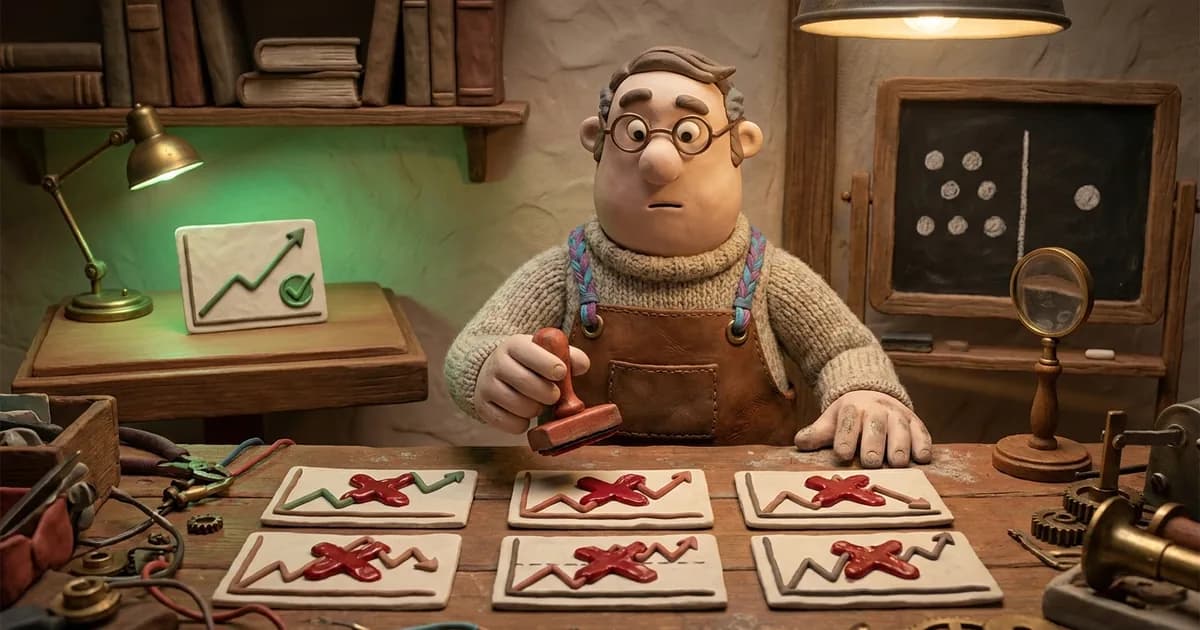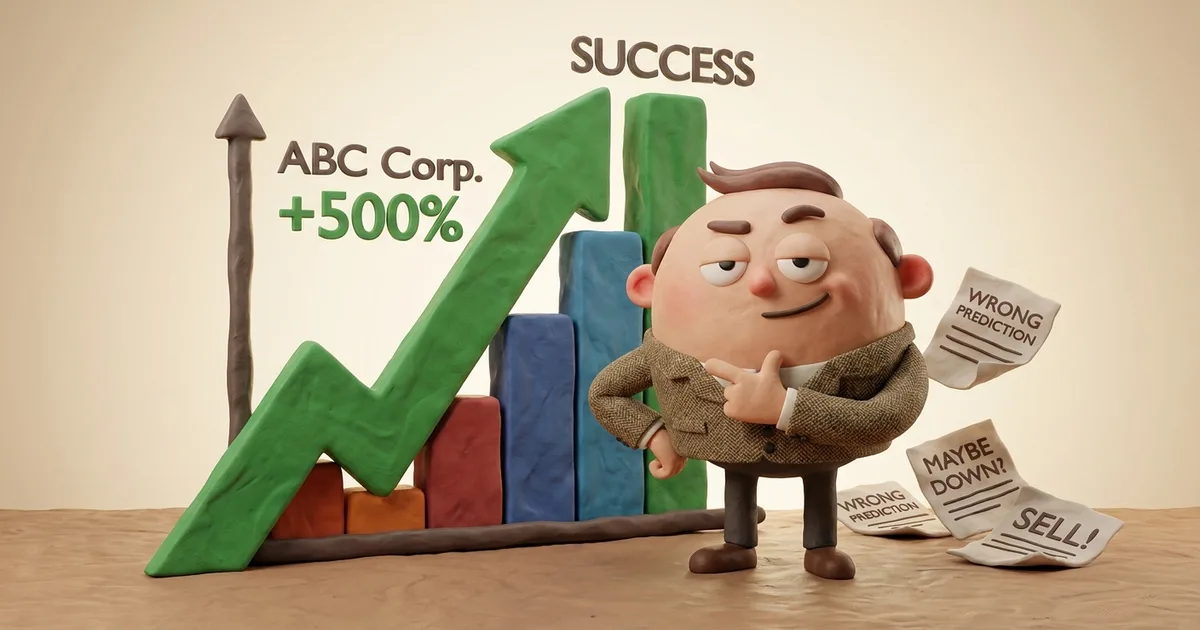
It's January 2, 2015. NVIDIA closes at about $20 (roughly $0.50 after the two later splits, 4-for-1 in 2021 and 10-for-1 in 2024).
Question: do you buy?
Your answer right now is probably yes. Obviously yes. AI was coming. Gaming was growing. Data centers were the future. Jensen was a visionary.
Bullshit. Your 2015 self would have bought Intel. Or GE. Or IBM. Or Qualcomm. NVIDIA was a gaming chip company whose biggest product line was GTX 970s for teenagers.
Welcome to hindsight bias — the silent killer of your trading confidence.
What It Is
Hindsight bias is the mental trap where outcomes feel inevitable in retrospect. The winners look obvious. The losers look foreseeable. Your past decisions feel either brilliant or stupid with perfect clarity.
None of it is real. You're pattern-matching a story onto random outcomes.
The Data
In early 2015, here's roughly how NVIDIA looked on the metrics Sandra uses:
- Revenue growth 3Y CAGR: low-single-digit. Unimpressive.
- Free Cash Flow margin: high-teens. Decent, not exceptional.
- ROIC: mid-teens. Above average, not extraordinary.
- Market cap: ~$11-13 billion. Mid-cap.
- PE ratio: ~18x. Not cheap.
Now let me show you two companies with similar 2015 fundamentals:
| Company | 2015 Revenue Growth | 2015 FCF Margin | 2015 ROIC | 2015 MCap |
|---|---|---|---|---|
| NVIDIA | 2% | 19% | 14% | $13B |
| Intel | -1% | 26% | 20% | $160B |
| Qualcomm | 8% | 27% | 19% | $80B |
| IBM | -12% | 15% | 16% | $135B |
Reading those numbers in 2015, you pick Qualcomm. Higher growth, higher margin, higher ROIC, larger company. Maybe Intel for safety.
Fast forward 10 years:
- NVIDIA: +10,000+%
- Qualcomm: +140%
- Intel: -50%
- IBM: -10%
The metrics did not predict the outcome. NVIDIA's winning condition — the AI boom — was not visible in the 2015 financials.
In 2015, these four looked similar. Ten years later:
NVIDIA's 2015 fundamentals (2% growth, 19% FCF, 14% ROIC) were the weakest of the four. The outcome had nothing to do with the data.
NVIDIA's bar is truncated at +1,000% — the real number is +10,000%. In 2015 it had the lowest revenue growth and ROIC of the four. Whatever "obvious in hindsight" signal you think you spot today — you didn't have it then.
Why This Screws You Up
You see the chart. NVIDIA from $5 to $500. You think: "I could have caught that."
Then you apply that belief forward. You look for "the next NVIDIA." You imagine you have pattern recognition you don't have.
Here's what you actually have: a story about one success that survived when 50 other similar bets failed. Out of every "future NVIDIA" bet made in 2015, one became NVIDIA. The other 49 became GoPro, Fitbit, Snap, Blue Apron, Teladoc.
Selection bias meets hindsight bias. You remember the win. You forget the 49 losses.
How It Showed Up in Sandra's Strategy
Sandra picked 15 stocks. Meta. Axon. Netflix. Broadcom. Crowdstrike.
Each name comes with a story. "Axon has the body-cam monopoly. Obvious." "Crowdstrike is the leading endpoint security play. Obvious."
Here's what's missing from those stories: the 2018 version of Axon, when it was a mediocre stun-gun maker with unclear margins. The 2019 Crowdstrike IPO at $63, that analysts said was "priced for perfection."
Both were not obvious. They became obvious after 10x returns.
Pick those names today, in 2026, and you're selecting on the outcome. That's hindsight pre-baked into your universe.
The Reverse Problem — Remembering Losses That Weren't Obvious Losses
Hindsight bias works both ways. You remember companies that crashed as "always sketchy." But at the time, they had credible stories.
- Enron (2001 collapse): Voted "America's Most Innovative Company" for 6 straight years by Fortune. Wall Street analyst consensus was "strong buy" one week before filing.
- Lehman Brothers (2008): A 158-year-old investment bank. S&P rating A+ three months before bankruptcy.
- Silicon Valley Bank (2023): Ranked among America's best banks by Forbes in February 2023. Collapsed in March 2023.
You didn't foresee those either. You just remember them now as "obvious" red flags, because the outcome colors the memory.
The Trading Implication
Hindsight bias makes you overconfident. You think you have skill you don't have. You bet bigger than you should. You hold longer than you should. You believe the next "obvious" winner is obvious.
Counter-move: keep a forecast log.
Write down, with timestamps, your predictions about specific stocks over the next 12 months. Review in 12 months. How many were right? Most people who try this discover their hit rate is around 50-60 percent, not the 80+ percent their memory suggests.
If you're honest about your track record, hindsight bias shrinks.
My Own Test
Before writing this article, I tried to pick "the next NVIDIA" from 2015 data. My guesses:
- Qualcomm (wrong, underperformed)
- AMD (right, up 30x)
- Apple (right, up 6x but already big)
- Cisco (wrong, sideways)
- Micron (wrong, boom-bust)
Score: 2 out of 5. Slightly better than random.
That's my edge. Slight. Useful. Not genius.
Before this exercise, I'd have told you my hit rate was 80 percent. That's hindsight bias in action.
What to Do With This
1. Assume past winners were not obvious. They looked like their cohort. They got lucky or skilled. You couldn't predict them.
2. Trust systematic signals over stories. A momentum filter doesn't care about stories. It just sees rising prices. That saves you from curating your own obvious-in-retrospect narrative.
3. Keep a public forecast log. Twitter works. Newsletters work. Something timestamped that embarrasses future-you into honesty.
4. Build strategies that work on ordinary data. If your strategy needs you to spot the next NVIDIA, it's not a strategy. It's a lottery.
The momentum strategy we published — top 10 by 12-month return — doesn't require foresight. It just rides what's working right now. It works because hindsight bias cannot corrupt a purely forward-looking signal.
-> Previous: Look-Ahead Bias -> Next: Overfitting — the bot that memorized -> Back to pillar
Sources
- Kahneman on Hindsight Bias — Thinking Fast and Slow, chapter on narrative fallacy
- Philip Tetlock — Superforecasting — hit rates of expert predictions
- NVIDIA 10-K 2015 — primary source for 2015 financial data
Your Dominic, who picks 2 out of 5 like everyone else.
Disclaimer: Not financial advice. Past performance does not guarantee future results.