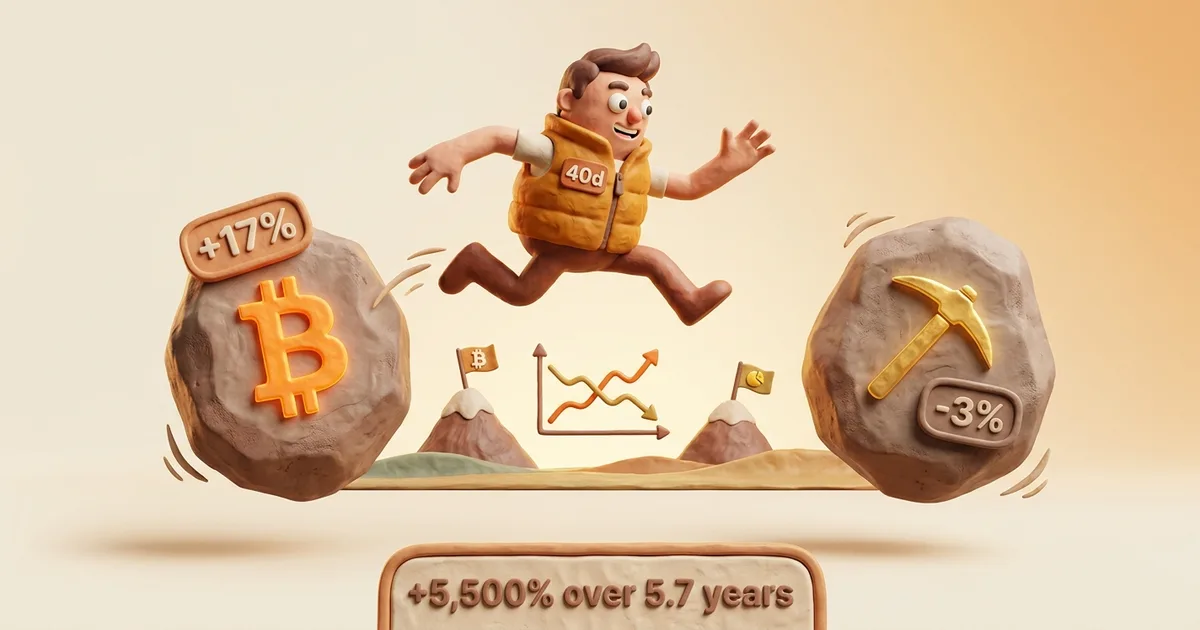
Picture a rabbit with two gardens to choose from.
In one garden, lettuce grows fast — sometimes explosively. But every few years a fox shows up and the lettuce gets trampled for months. That's Bitcoin.
In the other garden, the lettuce grows slowly but steadily. The fox rarely visits because the soil is older, calmer, more boring. That's gold mining stocks.
A normal investor picks one garden and stays there forever. They cheer when their lettuce grows, suffer when the fox comes, and stay loyal no matter what.
The Hedge Hopper does something simpler. Each morning the rabbit hops to whichever garden currently has the freshest growth. If both gardens are wilting, the rabbit sits in the burrow and waits.
Same lettuce. Same gardens. Same fox. Just a rabbit smart enough to hop between them.
That one habit, applied across 5.7 years of real data, turned $10,000 into $561,000 in backtest — while just-staying-in-Bitcoin turned the same $10,000 into $71,000.
This is The Hedge Hopper. Bot #7 in our lineup. Paper-traded with $10,000 virtual capital. Running since 2026-04-17.
The whole strategy in one sentence: "Today, which has stronger 40-day momentum — Bitcoin or the Gold Miners ETF? Hold whichever wins. If neither is positive, hold cash." Same question as our Rotator, different assets — instead of BTC vs ETH, this one pits BTC against GDX.
Why gold miners instead of ethereum? Because they're almost nothing alike. And that's the entire point.
Why Gold Miners?
Bitcoin and gold miners sound like they have nothing in common. And in the day-to-day, they don't. But step back and both are variations of the same bet: "I don't trust paper money in the long run."
- Bitcoin: digital scarcity. Fixed supply. Retail-driven. Trades 24/7.
- Gold Miners (GDX): leveraged exposure to the gold price. Institutional. Only trades during US market hours. Tracks physical gold with a multiplier.
Both are essentially the same bet in different wrappers. But their cycles rarely line up. When crypto was in its winter (2022), gold miners were just starting a massive two-year run — central banks were buying physical gold at a record pace, geopolitical tensions pushed flight-to-safety demand, inflation worries made hard assets look attractive. When Bitcoin ripped in 2023-2024, gold miners paused. That zig-zag is exactly what the rotation exploits.
That mismatch is the opportunity.
Back to the rabbit: When the lettuce in Garden BTC withers, the lettuce in Garden GDX is often peaking — or vice versa. The rabbit doesn't know why. It doesn't have to. It just knows which garden has the fresher leaves today.
The Backtest, Honest Edition
Tested on 5.7 years of data (2018-07 to 2026-04). That's how far back we have clean, weekday-aligned data for both assets — Bitcoin trades every day, gold miners only on stock market days, so we had to align to weekdays.
Realistic 0.10% trading costs. Out-of-sample — no parameter tuning on the test data.
| Metric | Hedge Hopper (40d) | BTC HODL | GDX HODL |
|---|---|---|---|
| Total return | +5,532% | +610% | +365% |
| Max drawdown | -45% | -77% | -64% |
| Trades per week | 0.51 (~27/year) | — | — |
| Walk-Forward | 3 of 3 windows beat HODL | — | — |
Two things to notice:
The return is roughly 9× BTC HODL over the same window. From $10,000, you'd have $561,000 vs. $71,000 in BTC or $46,500 in GDX alone.
The worst drawdown is nearly half of BTC's. -45% is still brutal, but it's the difference between "I can sleep at night" and "I can't." That's not a magic trick — it's because when one asset is tanking, the rotation usually moves you into the other or into cash.
In dollars: $10,000 in 2018 → $561,000 today with the rabbit hopping. Same money in BTC → $71,000. Same money in gold miners → $46,500. The hopper isn't picking better than either garden — it's picking whichever garden is currently growing.
Remember: Total return matters less than the combination of return AND drawdown. Anyone can chase +5,000% in one season. Doing it while cutting your worst-loss in half is what actually compounds.
BTC and Gold Miners take turns leading
5 years of illustrative cumulative returns. The Hedge Hopper rotates to whichever has stronger 40-day momentum.
The Walk-Forward Test
This is where most strategies die, so let's go slowly.
We split the 5.7 years into three independent chunks of roughly equal length. We pretend we're testing the strategy for the first time in each chunk. If the rule is real, it should work in all three — different market conditions, different dominant assets, different macro.
- W1 (2018-07 → 2021-03): crypto crash, recovery, first DeFi wave, gold beginning its run
- W2 (2021-03 → 2023-11): 2021 BTC top, crypto winter, FTX collapse, massive gold run
- W3 (2023-11 → 2026-04): ETF approvals, BTC all-time highs, gold continues strong
Result: all three windows beat HODL. Not by luck — in W2 the bot was in GDX for most of the crypto winter and preserved capital while BTC crashed.
This is what we call the "gold standard" for walk-forward: 3 of 3. Same score as our Watchdog and Rotator bots.
Back to the rabbit: In W2 (the crypto winter), Garden BTC was barren for two years straight. A rabbit loyal to that garden starved. Our hopper noticed Garden GDX growing again and moved over — and quietly fed there until BTC came back to life.
The Plateau Check (Important)
Remember the lesson from our retired Sharpshooter? A strategy that only works at one specific parameter value is usually a statistical fluke. A strategy that works across a whole range of nearby parameter values is more likely real.
We tested 13 different lookback windows from 10 days to 90 days:
| Lookback | Return | Walk-Forward |
|---|---|---|
| 10d | +830% | 2/3 ✓ |
| 20d | +1,439% | 2/3 ✓ |
| 30d | +5,352% | 2/3 ✓ |
| 40d | +5,532% | 3/3 ★ |
| 60d | +1,429% | 2/3 ✓ |
| 90d | +1,101% | 2/3 ✓ |
12 of 13 lookback variants beat HODL in at least 2 of 3 windows. The 40-day variant is the only one to hit the perfect 3/3, but its neighbors (20d-60d) are all solidly profitable. That's a real plateau, not a lucky peak.
We ship the 40-day version because it has the best walk-forward score. If the backtest had shown 40d as a lonely spike surrounded by losing neighbors, we would NOT have shipped it. That's the Sharpshooter rule.
Remember: A real edge is robust to small changes in the rules. If the rabbit's "check the gardens every 40 days" rule only works at exactly 40 — and breaks at 35 or 45 — then it wasn't really about the gardens. It was about the rabbit getting lucky with one specific number. Real signals don't care about exact numbers.
Why 40 Days?
A 40-day momentum window means: compare today's price to the price 40 weekdays ago (about 8 weeks).
- Too short (5-10 days): you flip in and out too often. You pay more in fees. You react to noise.
- Too long (90+ days): you're slow to rotate. When GDX starts rallying, you're still stuck in BTC.
- 40 days: long enough to ignore daily noise, short enough to catch 3-6 month trend changes.
The rule isn't magic — it's a tradeoff between reaction speed and whipsaw resistance. 40 happens to be the sweet spot in our data.
The rabbit's rhythm: Hops between gardens roughly every 6-8 weeks on average. Often stays put for months when one garden is clearly winning. Goes to the burrow (cash) when both are wilting.
What Could Kill This Strategy
Three honest risks:
1. The 2020-2024 gold run was historically unusual. Central banks bought gold at a record pace. Geopolitical tensions (Russia, China, Middle East) drove flight-to-safety demand. If the next decade's gold cycle is milder, the rotation loses some of its power.
2. Correlation could tighten. If Bitcoin and gold miners start moving together — both seen as debasement hedges during a dollar crisis — rotation between them loses its edge. You'd essentially own one asset dressed up as two.
3. We only have one full rotation cycle of data. 5.7 years. That's borderline for a cross-asset momentum claim. More years would strengthen the case. For now, it's suggestive, not proof.
None of these are deal-breakers. They're reasons to keep watching live performance rather than assuming the backtest guarantees the future.
Bottom line on risk: The +5,532% backtest is real, with caveats. The strategy depends on BTC and GDX continuing to dance to slightly different drums. If they ever start dancing in perfect sync, the rabbit has nowhere to hop.
What We're Watching
Starting today, the bot runs live. Every 6 hours it checks: "is BTC's 40-day momentum stronger than GDX's 40-day momentum?" Whichever wins (if positive) gets all the capital. If both are negative, it sits in cash.
For the next 45 days we're collecting live data to check whether the backtest prediction holds up. Same as every new bot we launch — see Live ≠ Backtest for why this matters.
If the live 45-day performance is dramatically different from the backtest expectation, we update our confidence and report it. If it roughly matches, we keep running. Either way, the data gets published.
First check (2026-04-17): the bot chose BTC. Momentum was +17% BTC vs. -4% GDX. The rotation works as designed on day one.
The Bigger Picture
We now have four momentum bots running:
- Tactician 2.0: BTC alone, vol-scaled
- Rotator: BTC ↔ ETH
- Tri-Rotator: BTC ↔ ETH ↔ SOL
- Hedge Hopper: BTC ↔ GDX (this one)
Each captures slightly different behavior. Tactician rides one asset. Rotator and Tri-Rotator rotate within crypto. Hedge Hopper rotates across asset classes — crypto and precious metals.
They're not duplicates. They're variations of "hold the strong thing, dodge the weak thing" applied at different scopes. In a crypto-dominated year, Hedge Hopper will probably sit in BTC and behave like Tactician. In a hypothetical year where gold rips and crypto consolidates, Hedge Hopper will be the only bot still making money.
That's the bet.
Why have all four? Because we don't know which "garden" the future is going to favor. Run all four, let live data decide which one matches reality, retire the underperformers honestly. That's the methodology.
For Quants: Raw Metrics
- Period tested: 2018-07-16 to 2026-04-15 (5.7 years, weekday-aligned)
- Lookback: 40 trading days (8 weeks of market-day momentum)
- Signal: argmax(mom_btc, mom_gdx) if any positive, else cash
- Fees: 0.10% per trade (Bybit/Binance taker, standard ETF spread)
- Total return: +5,532% (CAGR ~98%)
- MaxDD: -45%
- Annualized Calmar: ~2.2
- Trades/year: ~27
- Walk-Forward: 3/3 (all three 1.9-year sub-periods beat HODL)
- Parameter robustness: 12/13 lookbacks (10-90d) beat HODL in 2+/3 walk-forward windows
- Data sources: Binance for BTC, Yahoo Finance v8 chart API for GDX
- Execution: paper trading, cron-based, 6h interval, $10,000 virtual capital
The Hedge Hopper runs live on bearbullradar.com/bots. No real money. Full transparency. If it fails, it joins our post-mortems.
Related: The Rotator (the BTC↔ETH cousin) · The Tri-Rotator (3-asset extension) · The Surfer (regime-aware grid bot, our newest)
Validation Status — v2.1 (2026-04-28)
| Field | Value |
|---|---|
| Tier | Tier 1 — PROMOTED 2026-04-28 (paper-tracking) |
| v2.1 path | Path 1 — return-superior vs S&P 500 |
| Walk-Forward beat-rate vs S&P | 80% (20/25 windows), avg excess +170pp, median +71pp |
| Recent era 2023-26 | 100% (6/6 windows), avg excess +79pp |
| Sharpe | 1.39 (Path 2 partial support) |
| Multi-X | 7/7 STRONG across BTC + each of GDX, GLD, SLV, TLT, XLE, SPY, TIP |
| Status | Paper-tracking under all-paper policy |
Honest caveat: Hopper holds BTC most of the time. "Beats S&P" is partly "BTC HODL beats S&P" with light filtering — which is why we anchor on Sharpe + Multi-X (7/7), not return alone.
Real-money eligibility: ≥6 months forward-validated proof required. First eligibility window: 2026-10-28. See /methodology for the full v2.1 multi-benchmark framework + Real-Money Graduation Criteria.