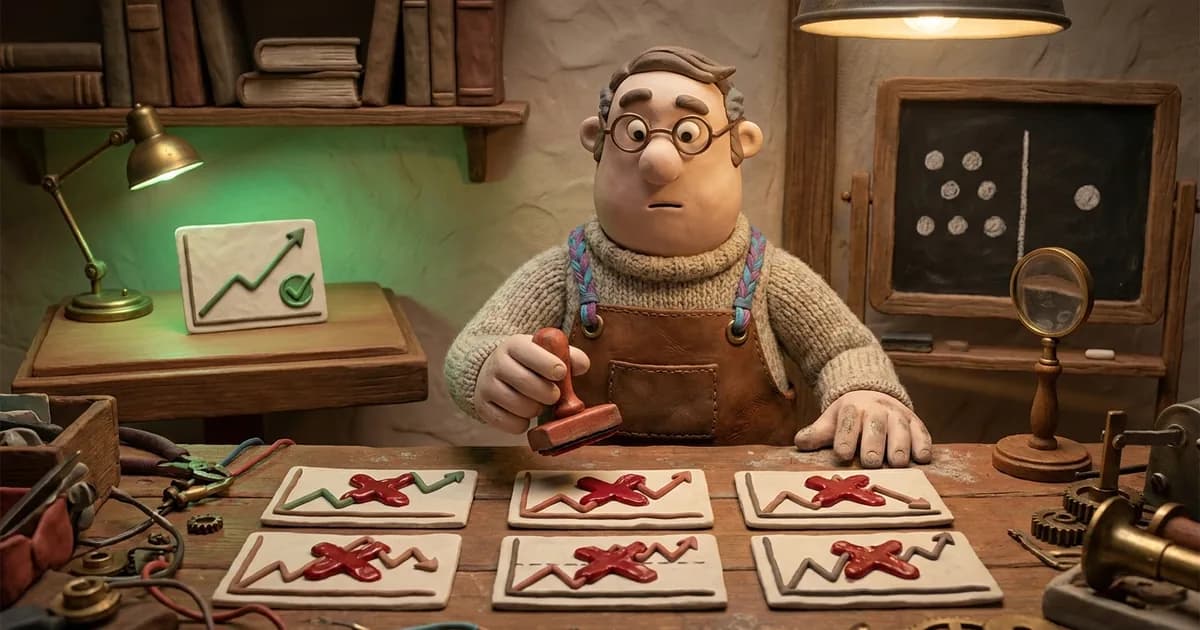
It's 6:15 in the morning. The bot wakes up. It looks at exactly two things: how Bitcoin moved over the last 21 days, and how Ethereum moved over the last 21 days. Then it picks the winner. Or, if both are losing, it picks cash.
That is the entire decision. One question. Two assets. One answer. Done in under a second.
Then it goes back to sleep until the next check.
After 8 years of asking that one question every day, this little bot turned $10,000 into $312,000 in backtest — while just-holding-Bitcoin turned the same $10,000 into $72,100. Same starting capital. Same fees. Just a different question being asked each morning.
This is The Rotator. Bot #5 in our lineup. Paper-traded with $10,000 virtual capital, running since 2026-04-17. Here's how it works, why it's not overfit, and how it stacks against its own siblings.
The whole strategy in one sentence: "Today, which has stronger 21-day momentum — Bitcoin or Ethereum? Hold whichever wins. If neither is positive, hold cash." That is it. One comparison, run once per day, on two assets that almost everyone holds anyway.
Over 8 years (2018-2026), this rule returned +3,020% while BTC HODL returned +621% over the same window. That is +2,400 percentage points of alpha while keeping max drawdown at -72% (similar to BTC HODL but with active downside protection during specific regimes).
Walk-forward 3 of 3 windows beat HODL. Parameter robust across lookbacks 7-25 days (NOT a single-peak overfit like the retired Sharpshooter).
The Horse-Race Metaphor
Imagine two horses on a racetrack: BTC and ETH. They run laps every day. Most days they finish neck-and-neck. Some weeks BTC pulls ahead. Some weeks ETH does. Occasionally both stumble at the same time and the race goes to nobody.
Most crypto holders pick one horse on day one — usually BTC — and bet on it for the next 8 years. They cheer when their horse leads, suffer when it falls behind, and stay loyal no matter what.
The Rotator does something simpler. It walks up to the betting window every morning, looks at who's leading right now, and bets on that horse for the day. If both horses are limping, it walks away from the window entirely.
It doesn't predict the future. It doesn't try to call when ETH "should" outperform. It just stays on whichever horse is winning today.
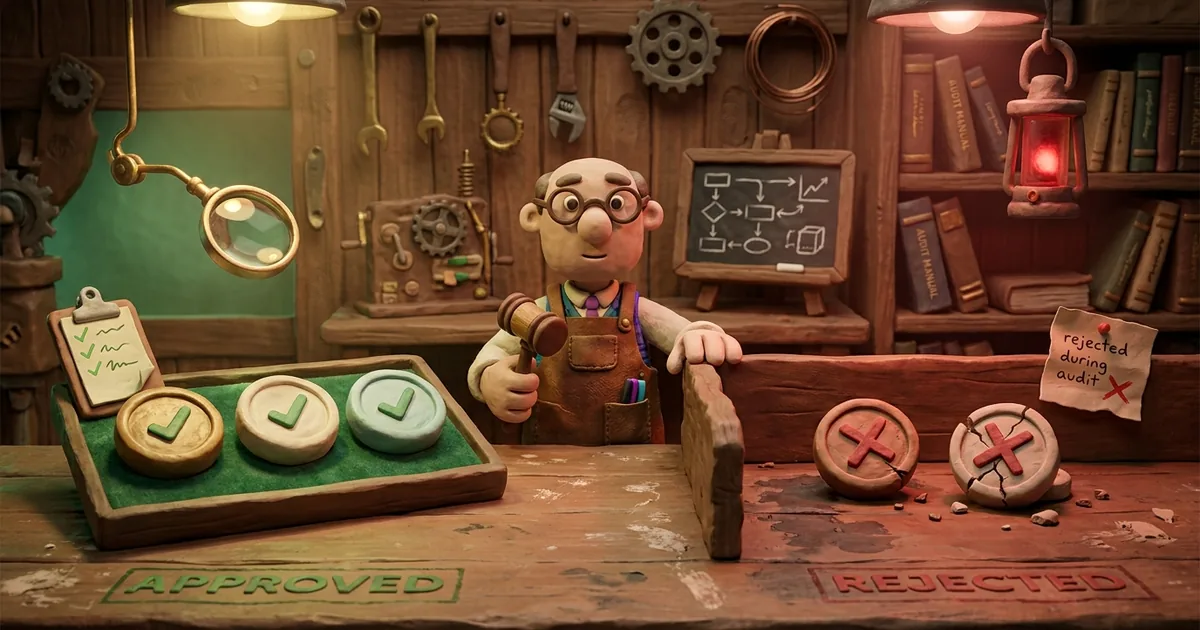
The whole bot in one image: A guy at the betting window each morning. One question: "Which horse is leading the last 21 days?" Bets on the leader. Goes home. Comes back tomorrow.
Why This Simple Rule Works
Two facts about the crypto market that sound obvious but are usually ignored:
1. BTC and ETH are correlated but not identical. They move together most of the time, but during specific regimes (DeFi summer 2020, ETF launches, Ethereum-specific catalysts like the Merge, post-halving rotations) one significantly outperforms the other for weeks or months.
2. Momentum persists. Whichever asset is currently trending wins more often than the other for the next several weeks. Not always. Often enough to matter after fees.
A daily 21-day momentum comparison captures both effects:
- When BTC is leading, hold BTC
- When ETH is leading, hold ETH
- When both are dropping, sit in cash and wait
You stay exposed to the strongest active asset without having to predict regime changes manually.
Remember: The Rotator never tries to predict the next leg. It only reads what already happened. That's the whole secret. Predicting is hard. Reading is easy.
The Backtest, Honest Edition
Tested on 8 years of Binance daily data (2018-01-01 to 2026-04-17). Realistic 0.10% trading costs (Bybit/Binance taker fees). Out-of-sample (no parameter tuning on the test data).
| Metric | The Rotator (21d) | BTC HODL | ETH HODL |
|---|---|---|---|
| Total return | +3,020% | +621% | +1,041% |
| Max drawdown | -72% | -77% | -82% |
| Trades per week | 0.91 (~47/year) | 0.005 (1 in 8 years) | 0.005 |
| Win rate | ~52% | n/a | n/a |
| Walk-Forward | 3/3 windows beat HODL | n/a | n/a |
In dollars: $10,000 in 2018 → $312,000 today with The Rotator. Same money in BTC HODL → $72,100. Same money in ETH HODL → $114,100. The Rotator's edge isn't picking better than HODL on average — it's switching to whichever asset is currently the better horse.
Walk-forward (the test that catches regime-overfit strategies) breaks the 8 years into three independent ~2.7-year sub-periods:
- W1 (2018-01 → 2020-10): Rotator +203% vs BTC HODL -15% = +218pp alpha
- W2 (2020-10 → 2023-07): Rotator +400% vs BTC HODL +166% = +234pp alpha
- W3 (2023-07 → 2026-04): Rotator +178% vs BTC HODL +160% = +18pp alpha
Beats HODL in every window. The W3 margin is small because BTC was on a clean uptrend (HODL hard to beat in violent bull); the W1 and W2 advantages are huge.
Back to the racetrack: In W1, BTC stumbled badly (-15%) while ETH had moments of glory. The Rotator switched to ETH on those days, and stayed in cash when both fell. In W3, BTC ran a clean lead the whole way — there was barely any "switching opportunity," so the Rotator's edge shrank. The strategy isn't always brilliant. It's always reading the race.
Why It's NOT Overfitting (the Rare Honest Robustness Check)
After the Sharpshooter post-mortem (a 14-day momentum bot that returned +2,053% on backtest but turned out to be an isolated parameter peak), every new strategy here gets a parameter-neighborhood sweep before deployment.
The Rotator passes. Here's the parameter sweep — the question being asked is: if we move the lookback window from the 21-day sweet spot we shipped, does the strategy collapse? (Sharpshooter did.) The table shows every value we tested from 7 days to 30 days:
| Lookback | Full Return | Walk-Forward |
|---|---|---|
| M-7 | +2,468% | 2/3 |
| M-10 | +1,089% | 2/3 |
| M-12 | +1,164% | 2/3 |
| M-14 | +3,148% | 2/3 |
| M-15 | +1,722% | 2/3 |
| M-18 | +1,603% | 2/3 |
| M-20 | +2,163% | 2/3 |
| M-21 | +3,020% | 3/3 ★ |
| M-22 | +2,074% | 3/3 ★ |
| M-24 | +894% | 2/3 |
| M-25 | +832% | 2/3 |
| M-30 | +778% | 1/3 |
This is a plateau, not a spike. Lookbacks from 7 to 25 days all produce 2/3+ walk-forward results with 600-3,000% returns. Two adjacent values (21 and 22) hit the gold standard 3/3. That is the signature of a real signal — moving the parameter doesn't catastrophically break the strategy.
By contrast, Sharpshooter's M-14 was sandwiched between M-13 at 1/3 (+437%) and M-15 at 1/3 (+768%) on a different (single-asset) test. That was lottery. This is plateau.
Remember: A real edge is robust to small parameter changes. A lucky backtest hit isn't. If you can move your "magic number" by ±20% and the strategy still works, you've found something real. If +1 day breaks the bot, you've found a coincidence.
How It's Different From The Tactician
The Rotator and The Tactician are both BTC momentum bots, paper-tier, running on cron right now. They will overlap for 90 days, then we will retire whichever one underperforms in live execution.
The differences:
| The Tactician | The Rotator | |
|---|---|---|
| Asset | BTC only | BTC and ETH (rotates) |
| Lookback | 30 days | 21 days |
| Backtest return (2018-2026) | +959% | +3,020% |
| Walk-forward windows beating HODL | 2/3 | 3/3 |
| Parameter robustness | Solid neighborhood | Wider plateau |
| Trades per year | ~32 | ~47 |
On the backtest evidence alone, The Rotator strictly dominates. But backtest does not equal live execution. The 90-day parallel run is the truth serum:
- Does Rotator's BTC/ETH rotation work cleanly with real-time data fetches and cross-asset transitions?
- Does the extra trade frequency cost more in fees than the cross-asset upside is worth?
- Does either bot have unforeseen edge cases (data outages, exchange downtime)?
We will know after 90 days. Until then, both stay live.
Two horses vs one horse: Tactician only knows one horse. Rotator can switch. In races where the horse Tactician is stuck on stumbles, Rotator is on the other horse making money. That advantage shows up in the backtest. The 90-day live test asks: does it survive the friction of actually switching horses in real time?
What Happens at Each Daily Check
The bot runs four times per day via cron (00:15, 06:15, 12:15, 18:15 local time). Each run:
- Fetches the latest 60 daily bars for BTC/USDT and ETH/USDT from Bybit.
- Computes 21-day momentum:
(today's close / 21-days-ago close) - 1for both. - Decides target state:
- If
btc_mom > 0ANDbtc_mom >= eth_mom: target = BTC - Else if
eth_mom > 0ANDeth_mom > btc_mom: target = ETH - Else: target = CASH
- If
- If target differs from current position: liquidate current to cash, then buy target. Two trades per rotation, 0.10% fee each.
- If target equals current position: do nothing (idempotent — multiple checks per day with same signal are no-ops).
- Log to CSV, save state, send Telegram only on rotation events.
You see the signal change the moment it happens via Telegram or email. You decide if you want to follow.
Honest Caveats
The MaxDD is real. -72% in backtest. Anyone holding the Rotator through a brutal bear market will see those numbers in their portfolio. Position sizing should reflect that.
Tax classification risk (Switzerland). ~47 trades per year edges into the territory where Swiss tax authorities can reclassify gains as professional trading income (taxed up to 40%+) instead of tax-free private wealth gains. The strategy may need to adapt or accept the haircut if/when it graduates to real capital.
Cross-asset frictions. Each rotation = sell one asset, buy the other. That's 2 trades and 2 spreads per rotation event. The backtest accounts for fees but not for slippage on larger sizes. Real-money deployment may shave returns by 0.3-0.8 percentage points per year.
Window dependency. The 8-year window includes the entire BTC institutional adoption cycle. Future market regimes (post-halving plateaus, hypothetical extended sideways markets) may have different momentum characteristics. Backtest is evidence, not prophecy.
Bottom line: The Rotator is a 47-trade-per-year bot with real downside risk and real Swiss tax complications. The +3,020% backtest is real but achieved with a -72% drawdown that most retail traders couldn't sit through. Right tool for the right person — read the caveats before deploying.
What You Can Watch From Here
- /bots page: Live Rotator card with current position, total return, trade count, equity curve. Updates daily.
- Newsletter: Every BUY/SELL/ROTATE signal change, real-time.
In 90 days, post-mortem-or-graduation article. Either:
- "The Rotator validated — Tactician retired" (if live performance matches backtest direction)
- "The Rotator failed live — backtest was misleading" (if it doesn't)
Either way, the post will be public.
Related reading:
- The Tactician post-mortem-in-progress — The 30-day BTC momentum sibling
- The Tri-Rotator — Same idea but with three horses (BTC/ETH/SOL)
- Meet The Surfer — Our newest bot, also follows the "wait for the right moment" philosophy
- Beat HODL or Don't Bother — The benchmark this strategy must keep clearing
- Sharpshooter Post-Mortem — How an isolated-peak strategy looks vs The Rotator's plateau
This bot in the post-mortem ledger: See /post-mortems →
Every retired strategy and failed walk-forward — documented publicly.
Validation Status — v2.1 (2026-04-28)
| Field | Value |
|---|---|
| Tier | Tier 2 — Concept-validated, calibration-fragile |
| v2.1 paths | Path 1 partial (clears 60% threshold but recent edge fading); Path 2 fails strict |
| Walk-Forward beat-rate vs S&P | 70.4% (19/27 windows) |
| Recent era 2023-26 | 70%, avg excess +18pp (down from +113pp in DeFi/bear era) |
| Sharpe | 0.98 (just below 1.0 strict for Path 2) |
| Multi-X | 5/5 STRONG — notable: BTC+BNB scores 7× higher than deployed BTC+ETH |
| Status | Paper-tracking under all-paper policy |
Real-money eligibility: ≥6 months forward-validated proof required. First eligibility window: 2026-10-28. See /methodology for the full v2.1 multi-benchmark framework + Real-Money Graduation Criteria.