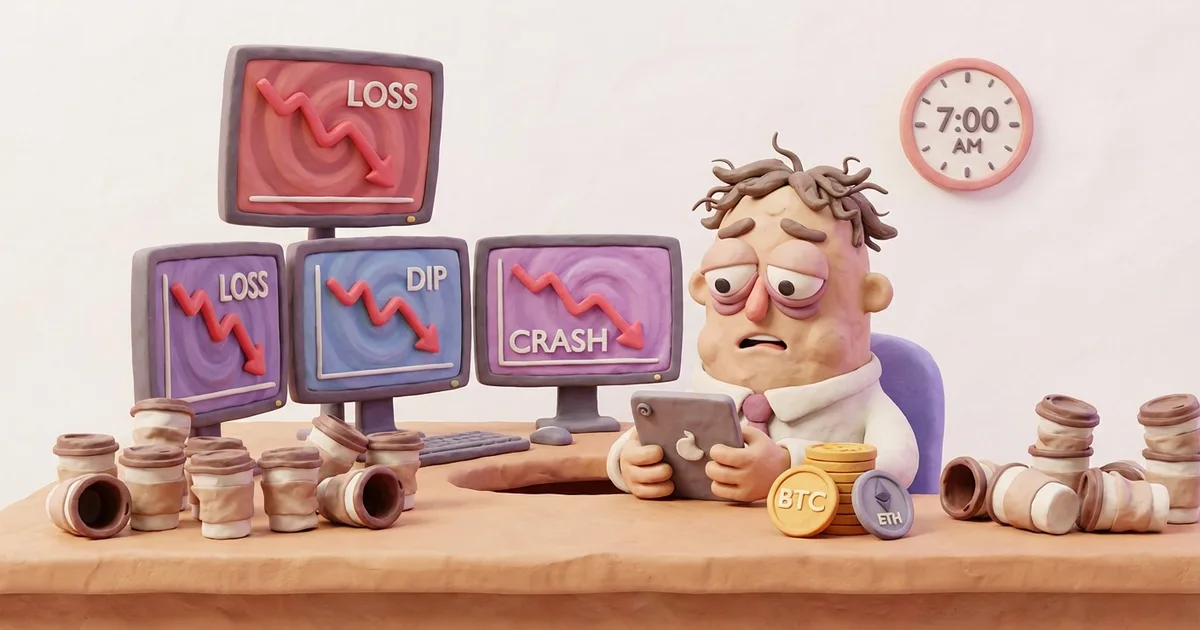
6:55 AM. The alarm goes off. You reach for your phone. Not for the news. For the charts. Bitcoin moved overnight. Your pulse spikes.
You open TradingView. Candles, lines, numbers. You spot a pattern. "This is it," you think. You open Bybit. Leverage: 10x. Long. Click.
3 minutes later: +2%. 200 dollars profit. You're a genius.
7 minutes later: -5%. 500 dollars lost. You're an idiot.
15 minutes later: Liquidated. Everything gone.
It's 7:12 AM. You haven't had breakfast yet.
Why am I telling you this? Because this is not an extreme example. This is the NORMAL morning for millions of daytraders worldwide. And science has measured what comes out of it.
In this article you'll learn:
- What daytrading really is (and why it sounds so tempting)
- What leverage trading is -- and why it will ruin you
- The real numbers: What 4 scientific studies say about daytraders
- Why you try it ANYWAY (psychology)
- And what actually works instead
Buckle up.
What Is Daytrading?
Daytrading means: You buy and sell within hours, sometimes minutes. You never hold overnight. You try to profit from small price movements.
Sounds easy. Sounds fast. Sounds like: "Trade for 30 minutes in the morning, hit the beach in the afternoon."
That's also why so many people try it. Instagram is full of 22-year-olds showing Lamborghinis and saying: "I trade 2 hours a day." YouTube has 500,000 videos titled "Day Trading for Beginners -- Start with $100."
What they don't show you: The 97% who lose everything.
But we'll get to that.
Why Is Daytrading So Tempting?
Three psychological traps make daytrading irresistible:
1. The Illusion of Control
You see charts. You analyze patterns. You make decisions. This FEELS like skill. Like an ability you can learn.
But here's the truth: Short-term price movements are largely random. Studies show that the predictive power of technical analysis on minute and hourly timeframes is near zero. You're not analyzing -- you're GUESSING. But your brain tells you you're analyzing.
2. Selective Memory
You remember the one trade that made +20%. That's the one you tell your friends about. The 15 trades that each lost -3%? You forget those. Or you rationalize: "I was just unlucky."
3. Variable Reward (the Slot Machine Effect)
Sometimes you win. Sometimes you lose. You never know when the next win is coming. Exactly this pattern -- unpredictable reward -- is the principle behind slot machines. It creates addictive behavior. Your brain releases dopamine not when you win, but when you EXPECT to win.
Remember: Daytrading is not investing. It's a slot machine with charts on it.
What Is Leverage?
Here's where it gets dangerous. Really dangerous.
Leverage means: You trade with borrowed money. If you have $1,000 and use 10x leverage, you're trading with $10,000. The exchange lends you the rest.
Sounds brilliant, right? 10x more profit!
Yes. And 10x more loss.
Example without leverage:
- You buy Bitcoin for $1,000
- Bitcoin rises 5% -> you have $1,050 -> Profit: $50
- Bitcoin falls 5% -> you have $950 -> Loss: $50
Same thing with 10x leverage:
- You buy Bitcoin for $10,000 (with $1,000 of your own money)
- Bitcoin rises 5% -> you have $1,500 -> Profit: $500 (50%!)
- Bitcoin falls 5% -> you have $500 -> Loss: $500 (50%!)
- Bitcoin falls 10% -> you have $0 -> LIQUIDATED. Everything gone.
At 10x leverage, a 10% move against you wipes out your ENTIRE capital. With Bitcoin, that happens regularly -- in a single day.
"But I use a stop-loss!"
A stop-loss is an automatic sell order: "If the price drops below X, sell automatically." Sounds like a safety net, right?
The problem: During fast crashes, the stop-loss often triggers too late. The price jumps past your stop -- that's called slippage. You wanted out at -5%, but you land at -12%. With 10x leverage, that's the difference between "small loss" and "account empty."
And even when the stop-loss works: With daytrading and many small trades, stop-losses eat your capital like fees. You don't lose from one big crash -- you die from a thousand small cuts.
The numbers are brutal:
In October 2025, $19.37 billion in leveraged positions were liquidated in just 24 hours. 1.6 million traders lost everything. Altcoins fell 60-80% within hours.
That's not a rare event. In September 2025, it was $1.65 billion in one week. 88% of those were long positions -- people who had bet on rising prices.
Remember: Leverage is like driving at 200 km/h without a seatbelt. In sunshine, it's thrilling. At the first curve, you're dead.
The Studies: What Science Says
Now it gets really sad. Because these are not opinions -- these are studies with tens of thousands of traders.
Study 1: The Brazilian Mega-Study (2019)
Researchers at the University of Sao Paulo analyzed ALL day traders who started trading on the Brazilian futures market (the third largest in the world) between 2013 and 2015.
| Result | Number |
|---|---|
| Traders who lasted > 300 days and lost | 97% |
| Traders who earned more than minimum wage | 1.1% |
| Traders who earned more than a bank teller salary | 0.5% |
| Average daily loss | -$49 |
And here's the kicker: The researchers found no learning effect. Traders who had traded for 2 years were NOT better than beginners. Experience doesn't help. You don't improve. You just lose for longer.
Study 2: University of California
- Only 13% of daytraders were profitable over 6 months
- Only 1% was profitable over 5 years
- 40% quit within the first month
- After 3 years, 87% are gone
Study 3: FINRA Report (2020)
The US financial regulator FINRA found: 72% of all daytraders suffered financial losses in 2020 -- a year in which the market overall ROSE.
Imagine that: The market goes up, and still 72% of active traders lose money. Because they try to time the market instead of simply being in it.
Study 4: ESMA -- European Securities and Markets Authority
ESMA analyzed CFD traders (Contracts for Difference -- leveraged trading) across all of Europe:
- 74-89% of all retail investor accounts lose money with CFDs
- Average loss per customer: EUR 1,600 to EUR 29,000
- The results were SO bad that ESMA limited leverage for retail investors to a maximum of 30:1 (for crypto: only 2:1)
When the REGULATORY AUTHORITY says "this is so dangerous we need to restrict it" -- maybe it's not a great idea.
The Summary in One Table
| Study | Sample Size | Loss Rate | Time Period |
|---|---|---|---|
| University of Sao Paulo (2019) | ~20,000 traders | 97% lose | 300+ days |
| University of California | Thousands of traders | 87% quit within 3 years | 5 years |
| FINRA (2020) | Entire US market | 72% lose (in a bull market!) | 1 year |
| ESMA (EU-wide) | CFD accounts | 74-89% lose | Ongoing |
The numbers vary between 72% and 97% depending on the study. But NO study shows a majority being profitable. Not a single one.
The following visualization shows what happens to 20,000 traders. Hover over the bars and you'll see how fast the numbers melt away:
Why Does Everyone Do It Anyway?
Because your brain works against you.
Survivorship Bias: You see the winners on YouTube. You DON'T see the 97% who quietly stopped and never talk about it.
Overconfidence Bias: "It'll be different for me." EVERYONE thinks that. The statistics are for other people. Not for you. You're smarter. You took a course. You have a system.
97% thought the same thing.
Sunk Cost Fallacy: "I've already lost $2,000 -- I can't stop now." Yes you can. And you should.
The Environment: Crypto Twitter, TikTok, Discord groups -- everyone is trading everywhere. It FEELS normal. But normal doesn't equal smart.
Remember: If 97% of doctors killed their patients, the profession would be banned. In daytrading, they call it "personal freedom."
What Actually Works Instead
The irony: The most boring approaches have the best results.
1. HODL / Buy-and-Hold Buy Bitcoin. Let it sit. For years. Beat 27 out of 30 active strategies in our backtest. Zero effort.
2. DCA (Savings Plan) Same amount every month. Regardless of whether the price is high or low. Automatic. No stress. No chart-staring.
3. BearBullRadar Bot (what our bot does) A simple trend filter that says: "Am I invested or not?" No daytrading. An average of 4 trades per YEAR. Still 3x better than HODL in our backtest.
None of these approaches is exciting. None makes you an Instagram guru. But all three make MONEY.
Conclusion: The Saddest Statistic in Trading
Let me summarize:
- 97% of daytraders lose money long-term
- 0.5% earn more than a bank teller salary
- Experience does not help -- there is no learning effect
- Leverage turns small mistakes into total losses
- In October 2025, $19 billion was liquidated in 24 hours
And yet, tomorrow someone will try again. Because the YouTube gurus show their Lamborghinis and the chart "looks good right now."
Don't be that someone.
-> Why 97% of Daytraders Lose -- The scientific explanation
-> HODL Beats 27 out of 30 Strategies -- The sobering result
-> Trading Calculator -- Is your trading worth it? Do the math
-> What Does the Bot Say Right Now? -- View current signal
-> Our 3 Bots -- What actually works instead
Your Dominic, the guy who tried it himself, saw the numbers, and built a bot. So emotions don't trade anymore.
Sources
- Chague, De-Losso, Giovannetti: "Day Trading for a Living?" (2019) -- University of Sao Paulo
- Day Trading Statistics 2026 -- Quantified Strategies
- ESMA: Product Intervention Measures on CFDs
- Crypto Liquidations October 2025 -- CNBC
- DayTrading.com: Facts & Statistics
Disclaimer: This is not financial advice. All numbers are based on scientific studies and public data. Past results do not guarantee future performance. Only invest what you can afford to lose.