My wife once asked me: "What happens if it all goes to zero?"
I was sitting at the kitchen table. Laptop open. Bybit. Portfolio in the five figures. And I didn't have a good answer.
"Then... it's gone."
She didn't say anything. But I saw the look on her face. And in that moment I knew: This can't go on like this.
Why am I telling you this? Because that question — "What if it all goes to zero?" — is the most important question in crypto investing. And most people never answer it. Until it's too late.
In this article I'll show you:
- The one rule that gave me my sleep back
- Why "play money" isn't just a feeling but a concrete technique
- What would have happened if I'd applied it to FARTBOY
- And why my bot enforces this rule automatically
Let's go.
The Rule
It's brutally simple:
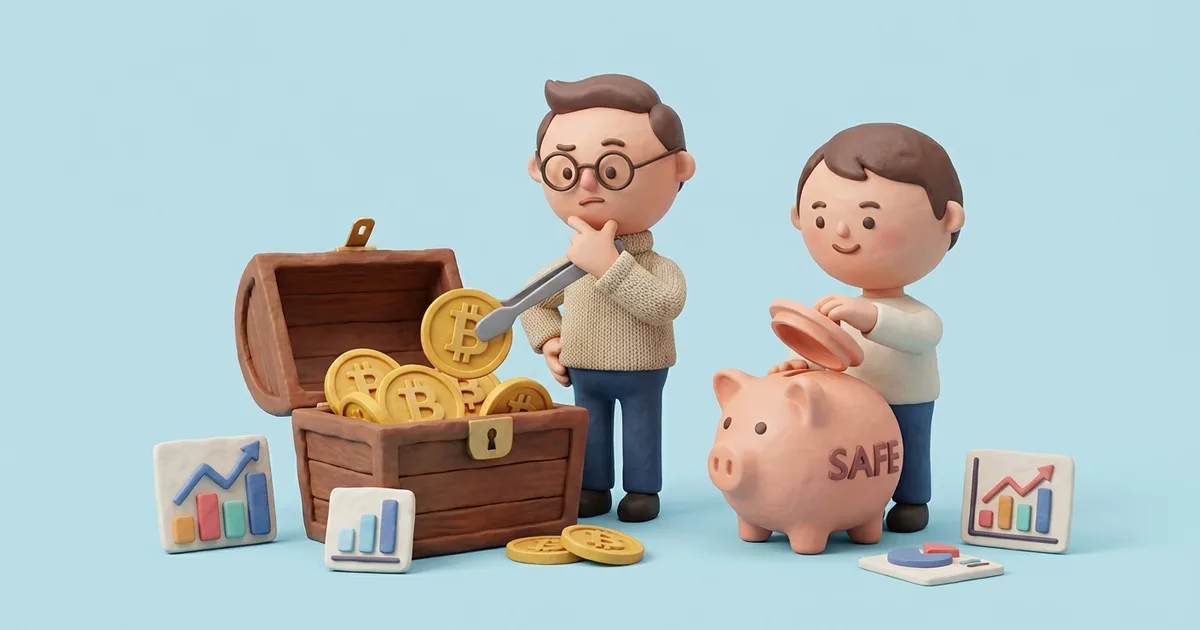
Remember this: As soon as you can, take out what you put in. The rest is play money. And you sleep better with play money.
Sounds trivial? It is. But almost nobody does it. Because it means: selling when things are going well. And that feels WRONG.
You think: "Why should I sell now? It's still going up!" Exactly. And that's why you didn't sell at 178,000 CHF (Swiss Francs). And that's why 90% of FARTBOY holders didn't either.
What the Rule Actually Means
An example. My XRP story:
| Step | What happened | Result |
|---|---|---|
| Invested over 3 years | Several thousand CHF, DCA at $0.80 | My stake is in |
| XRP rises to $2.40 | Portfolio tripled | Unrealized gains |
| Apply the rule | Sell half → initial investment is out | Investment back in my bank account |
| What's left | The other half in XRP | Pure play money |
After selling, my initial investment was back in my bank account. What was still in XRP was profit. If XRP drops to zero tomorrow? Too bad. But I haven't LOST anything. Just unrealized gains.
That's a fundamental difference.
The Psychology: Why Play Money Changes Everything
There's a psychological effect called the House Money Effect. Researchers have shown: people take MORE risk when playing with "house winnings" than with their own money.
At the casino: you win 500 CHF. Now you bet more loosely. "It's not MY money."
Normally that's a problem — it leads to stupid decisions.
But in crypto investing you can use this effect TO YOUR ADVANTAGE:
- Take your stake out → Now only "house money" is invested
- You make better decisions → Because losses don't hurt anymore
- You hold LONGER → Because you don't panic sell at -30%
- You sleep better → Because the worst-case scenario is bearable
Remember this: You make your best trading decisions when the loss doesn't hurt. And it doesn't hurt when it's not your money.
What Would Have Happened with FARTBOY
My most painful example. 2,500 CHF invested. Portfolio went to 178,000.
Without the rule (what actually happened):
- Didn't sell at 178,000
- Portfolio fell to 40,000
- Then partially sold: ~20,000 realized
- Feeling: loss of 158,000 CHF (even though it was "just" unrealized gains)
With the rule (what should have happened):
- At 5,000 (2x): take out initial investment → 2,500 CHF back
- Remaining position = pure play money
- Whether it goes to 178,000 or zero after that: I don't care. Stake is safe.
- Sell in stages at 5x, 10x, 20x: total ~55,000 CHF realized
55,000 instead of 20,000. And no guilt. No sleep deprivation. No "I should have sold."
But Isn't That Stupid? I'm Missing Out on Gains!
Yes. If FARTBOY had risen to 10 million, I would have made less.
And if FARTBOY had gone to zero — which with memecoins is the MORE LIKELY option — I'd still have my initial investment back.
The question isn't: "What's the maximum profit?"
The question is: "Can I live with it if everything goes to zero?"
If the answer is "No," you have too much of your own money in it.
How My Bot Implements the Rule
The beauty of a bot: it has no FOMO. No hope. No "but what if it goes even higher tomorrow?"
My bot follows clear rules:
- Three filters green → buy
- One filter red → sell
- No discussion. No exceptions.
That IS the rule, automated. The bot takes profits when the signals turn — not when it "feels ready." And it sells COMPLETELY, not "maybe a little bit."
2022: Bot sells at $43,000. Bitcoin falls to $15,500. Bot lost nothing.
I would never have pulled that off manually. At $43,000 I would have thought: "This is just a dip!" Just like with FARTBOY at 178,000.
My Stance Today
I've taken my initial investment out. What's in crypto is money I can afford to lose.
If I lose it now? Painful, but not life-altering. No divorce. No debt counselor. No sleepless nights.
And THAT is exactly the point. Not "how much can I possibly earn?" But: "How much can I lose without it changing my life?"
Everything beyond that: take it out.
Summary
- Take your initial investment out — as soon as you can. Not when it "feels right." As soon as you can.
- The rest is play money — and with play money you make better decisions.
- The question isn't "how much can I win?" — but "can I live with it if everything goes to zero?"
- Automate it — a bot has no FOMO. It sells when the rules say so.
Your wife will ask the same question. Or your partner. Or your conscience at 3 AM.
Have an answer ready.
→ How I Didn't Sell at 178,000 — The full FARTBOY story
→ 3 Years of XRP: Patience Beats FOMO — My most boring and best trade
→ DCA Savings Plan Calculator — Calculate your own savings plan
→ What Does the Bot Say Right Now? — Current signal
→ Our 3 Bots — Systems without emotions
Your Dominic, the guy whose wife asked the right question.
Disclaimer: This is not investment advice. Only invest what you can afford to lose. This article describes my personal approach, not a universal rule.
Update 2026-04-28: Validation later showed only the SMA(100) filter actually changes the Watchdog's buy/sell decisions — DM and LD are tracked for transparency but don't gate trades. The story above is still accurate (the bot stayed in cash; the SMA filter did the work). Full validation: /blog/waechter-2021-loss. The Watchdog is now Tier 2, paper-tracking under our all-paper policy.