From two pizzas worth 800 million dollars to the man who wants to buy his landfill. From a drunken forum post that became a philosophy to the president who bet an entire country on Bitcoin.
The crypto world is full of stories so crazy they'd have to be made up. But they're not.
Each of these 8 stories is real. Each has a lesson. And at least one of them you'll tell your father-in-law at the next family dinner.
1. The Most Expensive Pizzas in History
May 22, 2010. Laszlo Hanyecz, a programmer from Florida, posts in the BitcoinTalk forum:
"I'll pay 10,000 bitcoins for a couple of pizzas."
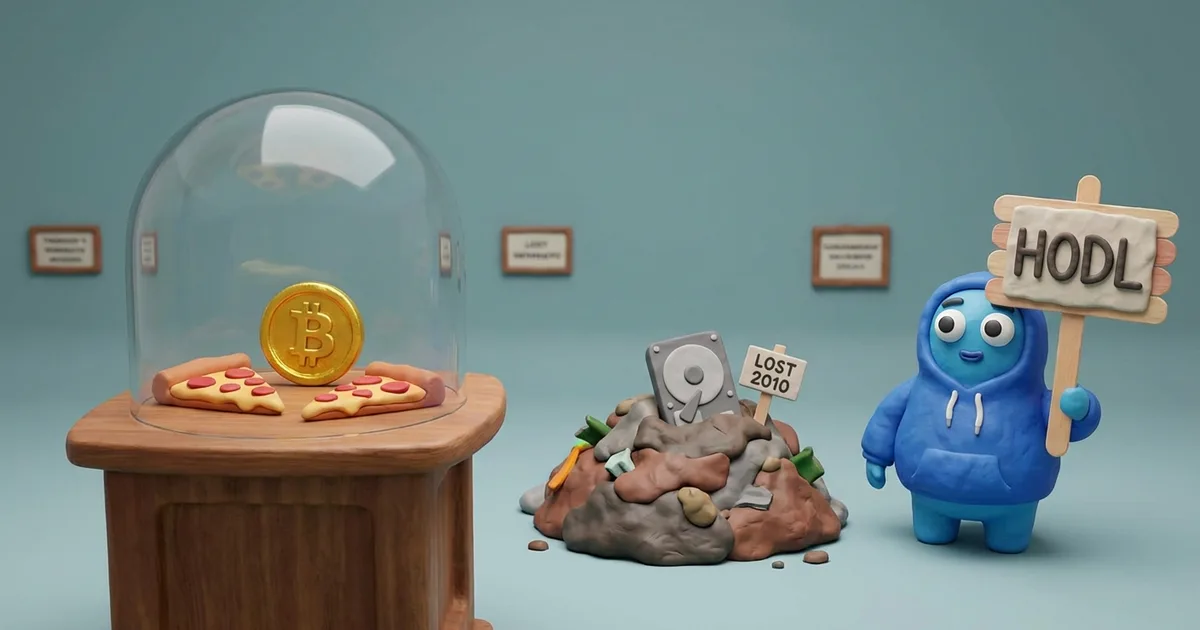
He waits four days. Then someone takes the offer and orders him two pizzas from Papa John's. Value of the pizzas: about 25 dollars. Value of the 10,000 Bitcoin: around 41 dollars at the time.
Today those 10,000 Bitcoin would be worth over $800 million.
But before you think "what an idiot": Laszlo was one of the very first Bitcoin miners. He developed the first GPU mining software and built the first macOS client for Bitcoin. He knew exactly what he was doing. Bitcoin had no market price back then. He proved you could actually BUY something with it. It was the very first real Bitcoin transaction in history.
Does he regret it? No. "Bitcoins had no value back then. The idea of trading them for pizza was incredibly cool."
Every year on May 22, the crypto world celebrates Bitcoin Pizza Day.
Lesson: Sometimes you make the "wrong" trade. And sometimes it was still the right decision at the time. Hindsight is not a benchmark.
2. 7,500 Bitcoin in the Landfill
2013, Newport, Wales. James Howells tidies up and throws away an old hard drive. On that hard drive: the private key to 7,500 Bitcoin. Worth a few thousand dollars at the time. Today: over $750 million.
For over 12 years he's been trying to recover the hard drive from the Newport landfill. The city council says: no. Howells offers to cover the costs. No. He offers the council a share. No. He sues the council for 495 million pounds. Dismissed. He offers to buy the entire landfill. The council plans to close it in 2025/26.
The court ruled in January 2025: once the hard drive ended up in the landfill, it became the property of the city council.
A documentary about the story is in production.
Lesson: Not your keys, not your coins. And: back up your backups. Under NO circumstances on a hard drive sitting next to the trash.
3. Two Attempts Left
2011. Stefan Thomas, a German programmer in San Francisco, receives 7,002 Bitcoin as payment for an explainer video ("What is Bitcoin?"). He stores the private key on an encrypted IronKey USB drive.
Then he loses the piece of paper with the password.
IronKey allows 10 password attempts. After that, the drive wipes itself. Permanently.
Stefan has used 8 attempts. All wrong. He has 2 attempts left. At the current price, the drive holds over $750 million.
A cybersecurity firm (Unciphered) has developed a method to crack the IronKey without triggering the self-destruct. They contacted Stefan. He declined because he already has a verbal agreement with two other teams.
As of today: the drive is still locked.
Lesson: $750 million, locked behind a forgotten password. Write your seed phrase down. On paper. In a safe. Not on a USB drive.
4. $40 Billion in One Week: The Luna Crash
May 2022. Do Kwon, 30 years old, has built the "unhackable" system: TerraUSD (UST), an algorithmic stablecoin backed by its sister token Luna. The system manages 40 billion dollars. On Twitter, Kwon writes: "By all means, go ahead and short it."
On May 9, 2022, UST begins losing its peg to the dollar. What starts as a small deviation becomes a death spiral. Luna falls from $119 to practically zero. UST from $1 to 10 cents. In one week.
$40 billion evaporated.
The ripple effects: Celsius Network goes bankrupt. Three Arrows Capital collapses. The entire crypto market crashes. Bitcoin falls from $47,000 to $15,500 over the following months.
Do Kwon flees. Gets arrested in Montenegro in 2023 with a forged passport. In August 2025, he pleads guilty to fraud. In December 2025, he's sentenced to 15 years in prison. The judge calls it "fraud of epic, generational proportions."
Lesson: When someone says "it can't go wrong," it CAN go wrong. And when the founder challenges you on Twitter to short it, run.
5. From Facebook Plaintiffs to Bitcoin Billionaires
2013. Cameron and Tyler Winklevoss, known as the twins who sued Mark Zuckerberg, invest 11 million dollars of their Facebook settlement into Bitcoin. At prices between $100 and $1,200 per coin. They buy around 100,000 BTC.
Everyone laughs.
"Bitcoin is a scam." "The Winklevoss twins have lost their money." "Nobody needs digital money."
2025: their position is worth over $7 billion. Return: over 72,000%. They founded Gemini, one of the largest crypto exchanges in the US, which went public on the Nasdaq in 2025.
They say: Bitcoin will reach 1 million dollars in 10 years. Are they right? No idea. But with their track record I wouldn't bet against them.
Lesson: Being contrarian is easy to say and almost impossible to sustain. The Winklevoss twins held on for 12 years while everyone laughed at them.
6. An Entire Country Buys Bitcoin
September 2021. Nayib Bukele, President of El Salvador, makes Bitcoin legal tender. The first country in the world. He starts buying Bitcoin with state funds. Again and again. At every dip.
The reactions: the IMF warns. Economists mock. Rating agencies downgrade the country.
Then Bitcoin rises. El Salvador's portfolio climbs to over $678 million with an unrealized gain of +132%.
But the story has a flip side too: in December 2024, as a condition for a $1.4 billion loan from the IMF, El Salvador had to revoke Bitcoin as legal tender. Merchants no longer have to accept it. Taxes can no longer be paid in Bitcoin.
In 2025, Bitcoin as a payment method in El Salvador has practically no significance anymore. But the portfolio keeps growing.
Lesson: Being contrarian can work. But timing and context matter. And betting an entire country on a volatile asset is a different thing from your personal portfolio.
7. Michael Saylor: All-In with Company Money
August 2020. Michael Saylor, CEO of MicroStrategy (a boring business intelligence company), buys Bitcoin with company funds. 21,454 BTC for $250 million.
Wall Street thinks he's lost his mind.
He keeps buying. And buying. And buying. At every price. Every quarter. Financed through bonds, stock offerings, anything he can find.
As of April 2026: MicroStrategy (now "Strategy") holds 780,897 Bitcoin, purchased for a total of $59 billion at an average price of $75,577. That's roughly 76% of all Bitcoin held by publicly traded companies.
Saylor is no trader. He never sells. He's the ultimate HODL maximalist. His line: "Bitcoin is digital property."
Does it work? So far, yes. The stock has multiplied several times over since August 2020. But: if Bitcoin drops sharply, the company has a debt problem. All-in works until it doesn't.
Lesson: Conviction can earn billions. But it can also destroy billions. Saylor has been right. So far. "So far" is the operative word.
8. "I AM HODLING"
December 18, 2013, 10:03 AM. Bitcoin has just fallen 39%. A user named GameKyuubi logs into the BitcoinTalk forum drunk and types:
"I AM HODLING"
His post begins with: "I type d that tyitle twice because I knew it was wrong the first time. Still wrong. w/e."
He explains that he's a bad trader. That he knows it. And that's why he simply holds. No matter what happens.
Within minutes "HODL" was a meme. Then a backronym (Hold On for Dear Life). Then a philosophy. Today it's in every crypto glossary.
Bitcoin on the day of his post: $438. Bitcoin today: over $80,000.
GameKyuubi, drunk and frustrated, accidentally formulated the most important investment rule of the crypto world.
Lesson: Sometimes the best strategy is having no strategy at all. Except: don't sell.
What All 8 Stories Have in Common
As different as they are, one thing connects them all:
Emotions are the biggest enemy.
Laszlo acted rationally, and feels good about it. Stefan acted emotionally (didn't secure his password), and is paying for it. Do Kwon acted out of arrogance. The Winklevoss twins acted AGAINST the emotions of the crowd.
And GameKyuubi? He was drunk enough to do the only right thing: nothing.
That's why I built a bot. Because I'm sober when I make decisions. And because being sober isn't enough.
→ HODL: The Full Story Behind the Word — From typo to philosophy
→ How I Didn't Sell at 178,000 — My own crazy crypto story
→ Musical Chairs: The Truth About Memecoins — Who pays for your profit?
→ The Sad Daytrader Statistics — Why 97% lose
→ Buy the Dip Game — Test if you can beat the market
→ My 3 Bots — Systems that know no emotions
→ What Does the Bot Say Right Now? — Current signal
Your Dominic, the guy who collected these stories so you don't have to live through them yourself.
Sources
- CoinDesk: 10 Years After Laszlo Hanyecz Bought Pizza With 10K Bitcoin (2020)
- CNN: Man who lost $800M bitcoin in landfill (2025)
- Gulf News: Stefan Thomas who lost $777M to a forgotten password
- CoinDesk: Do Kwon gets 15 years (2025)
- The Block: Winklevoss twins move $130M in bitcoin (2025)
- Wikipedia: Bitcoin in El Salvador
- CoinDesk: Michael Saylor's Strategy added 13,927 bitcoin (April 2026)
- BitcoinTalk: Original HODL Post (2013)
Disclaimer: This is not investment advice. The stories described are real events. Past results do not guarantee future outcomes.