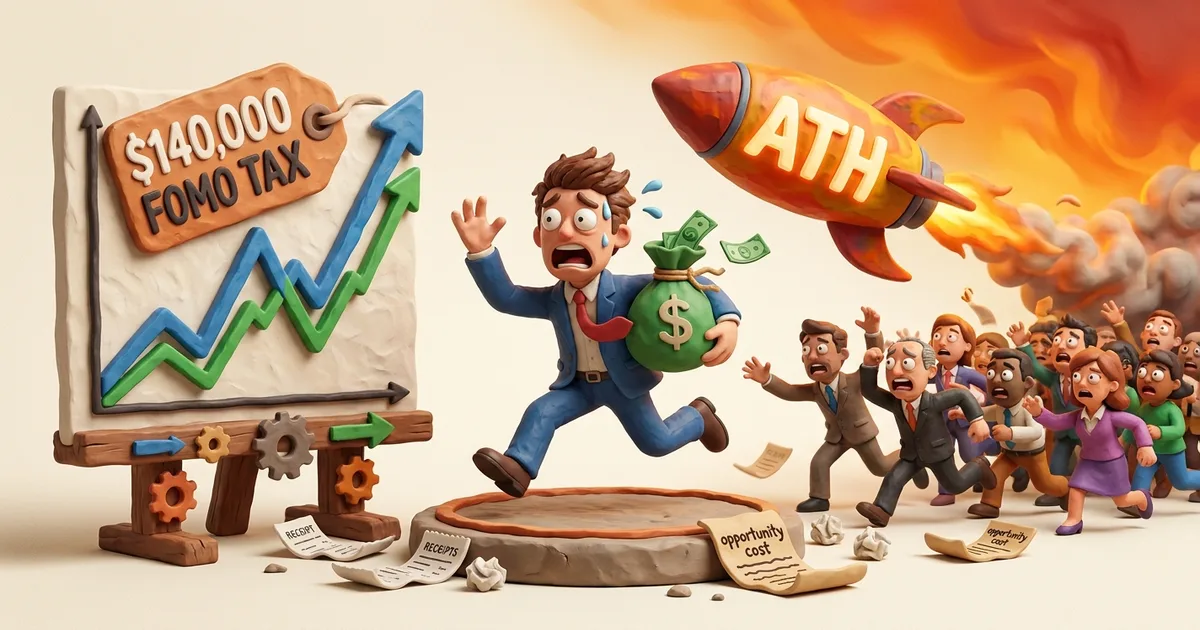
Before I built The Watchdog, I was the audience The Watchdog is designed to protect.
Between October 2019 and November 2023, across Bitcoin, Ethereum, and the XRP hole I fell into, I lost $140,000 USD to a single cognitive bias. Not a market crash. Not a scam. Not a bad strategy.
FOMO. Fear of Missing Out.
Not trader lingo. Not a meme. A very specific, documentable pattern where my brain said "everyone else is making money without me, I need to buy now, the price doesn't matter" — and then the market handed me a drawdown that would have made any rational entry-timing look catastrophic.
I'm writing this article because Sandra called me last Friday and told me she'd bought 3 ETH at $4,100, two days after the latest ATH. Her reasoning: "I missed the last run. I can't miss this one."
She paid the FOMO tax. I wanted her to know she's not alone — and that there's a way to stop paying it.
The Three Signatures of a FOMO Trade
You know you're in a FOMO trade when all three of these are true:
-
Social trigger first, analysis second. You heard about the move from Twitter, a friend, or a coworker — not from your own monitoring. Your "analysis" happened after you'd already decided to buy.
-
Price is at or near an all-time high. Normal rational buying can happen at any price. FOMO buying happens specifically at or near peaks, because the peaks are what make the social signal loud enough to break through.
-
"Any price is fine" mental frame. You're not asking "is this a good price?" You're asking "how much can I buy before it goes even higher?" Price sensitivity disappears.
If all three are firing, it's a FOMO trade. You can still execute it — just don't lie to yourself about what it is.
FOMO Trade #1: ETH at $480 (October 2019)
Ethereum had rallied from $85 to $480 between December 2018 and June 2019. Peaked, pulled back to $150, then rallied to $250 by October. A friend told me at a Zurich bar in mid-October: "I 4x'd on ETH. Classic altseason setup. Pattern's the same as 2017."
I bought 15 ETH at an average of $180. Told myself I was being "disciplined" because I wasn't buying at $250.
ETH then rallied to $480 by late October. I bought another 5 ETH at $450. Total position: 20 ETH, average cost ~$250.
By March 2020, ETH was at $110. COVID crash.
My average cost was $250. Position was down 56%. The $450 tranche — the pure FOMO entry — was down 76%.
I held. ETH recovered. The overall position eventually broke even in 2021 and went into profit. So "no harm done," right?
Wrong. The correct benchmark is: what if I had deployed that same capital into Bitcoin, which I'd already been holding for years? BTC was flat around $8-10k in that period, then ran to $60k. Every dollar I put into my FOMO-timed ETH entries would have been worth 2-3x more in BTC over the same window.
That opportunity cost is the FOMO tax. The position didn't have to go to zero to lose me money. It just had to underperform the obvious alternative I would have held otherwise.
Rough estimate of this one tax: ~$12,000.
FOMO Trade #2: BTC at $57k and $61k (February/March 2021)
Bitcoin had been at $10k in October 2020. By February 2021 it was $48k. Every newsletter, every Twitter account, every Telegram group I was in was shouting "this is the new institutional era — BTC will be $100k by Q3."
Tesla had announced its $1.5B BTC purchase. MicroStrategy was loading up. Michael Saylor was posting every day. Novogratz on CNBC.
I added $45,000 USD into BTC in two tranches: $57,000 (Feb 20) and $61,000 (March 13). Average cost: ~$59k. Position sizing: 10% of my liquid net worth at the time, which was already heavily BTC-allocated.
BTC peaked at $69k in November 2021. I didn't sell. Diamond hands, right?
By November 2022, BTC was $15,800. Position down ~73% from my FOMO entries.
By late 2024, BTC recovered to $100k+. Position broke even and beyond, finally. 3.5 years to get back to zero.
But again — opportunity cost. In early 2021, I could have been anywhere. I could have held cash for the obvious upcoming cycle top. I could have reduced crypto allocation after the clearly overheated run. I didn't, because FOMO. The signal was "everyone's making money, don't miss out." The analysis was post-hoc justification.
Rough estimate of this tax: ~$55,000 (measured as the loss I took at the cycle bottom vs staying in USD/low-duration bonds for 2021-2022).
FOMO Trade #3: The XRP Addition (2022-2023)
I already had an XRP bag from 2017-2018 (old story, bad idea, don't ask). It was dead money for years. In 2022, as the SEC lawsuit progressed, every XRP account on Twitter was claiming "imminent breakout." By mid-2023 the drumbeat was deafening.
I added $22,000 to my XRP position in the low-$0.40s, over three tranches between December 2022 and June 2023. Reasoning at the time: "If the SEC case resolves favorably, this is a 10x. If it doesn't, I'm already deep in, so the incremental risk is small."
Every word of that reasoning was post-hoc justification for FOMO.
The SEC case did resolve partially favorably. XRP rallied to $0.92 briefly. Then back to $0.50. Then the institutional adoption story that everyone predicted... never materialized. By mid-2024 XRP was $0.48.
My added $22,000 was down to $14,000. Tax: $8,000 realized, plus additional opportunity cost vs BTC (which did +100% in the same period): another **$22,000** in opportunity cost.
Sunk cost fallacy got me to hold the original bag. FOMO got me to add to it. The XRP post-mortem is its own article. This one's about FOMO specifically.
The Total Ledger
| Year | Trade | Position | Tax (realized + opportunity) |
|---|---|---|---|
| 2019 | ETH @ $250 avg | 20 ETH | ~$12,000 |
| 2021 | BTC @ $59k avg | 0.76 BTC | ~$55,000 |
| 2022-23 | XRP adds @ $0.42 avg | 52,000 XRP | ~$30,000 |
| Assorted | altcoin FOMO trades | various | ~$43,000 |
Total FOMO tax paid: ~$140,000 over four years.
That's the equivalent of a year of Swiss income. A downpayment. A small business. Gone not because my picks were wrong — most of them recovered — but because my timing was driven by social signals at peak emotional intensity, not by patient analysis at calm moments.
Why Your Brain Pays the FOMO Tax
Three mechanisms stack.
1. Social proof is evolutionary
For most of human history, "what everyone else is doing" was the right answer. If the whole tribe was running, you ran. If nobody was eating a certain berry, you didn't eat it. Following the crowd kept you alive.
Markets are one of the only environments where the crowd is systematically wrong at the extremes. Peak optimism = the moment to sell. Peak pessimism = the moment to buy. Your hardware says "do what the crowd does." The market math says "do the opposite." Your hardware wins by default.
2. Regret aversion is asymmetric
If you buy at the peak and lose 50%, you feel bad but in a way you can rationalize ("nobody saw it coming").
If you don't buy at the peak and miss a 50% run, you feel bad in a way that haunts you ("I KNEW, I watched it, I talked myself out of it"). This kind of regret is sharper and lingers longer.
The result: you'll choose "buy and maybe lose" over "sit out and definitely regret." Even when the expected value clearly favors sitting out.
3. Peak prices are the loudest prices
You never heard about Bitcoin at $15k in late 2022. It was boring. News cycle dead.
You heard about it every day at $69k in late 2021 and $100k+ in late 2024. The peaks generate the stories, the stories generate the FOMO, the FOMO generates retail inflows at exactly the wrong moment.
The media doesn't do this to hurt you. It does it because peaks are newsworthy. The feedback loop that produces FOMO is baked into how attention works.
The Mechanical Defense
You can't eliminate FOMO. You can pre-commit yourself to rules that bypass it.
Rule #1: No buys within 5% of a 6-month high
The cheapest, simplest FOMO filter. If BTC is within 5% of its 6-month high, you are not allowed to add to your BTC position that week. Full stop. The rule doesn't care about your rationalization. It's a hard rule.
This costs you some upside in genuine breakouts. It saves you an enormous amount in FOMO disasters. Net-net: positive EV for almost every retail investor.
Rule #2: Automated DCA beats discretionary timing
If you want exposure to Bitcoin, set up a weekly or monthly automatic DCA. Same amount, same day, automatic execution. You take FOMO out of the equation entirely. Sometimes you buy tops (bad luck), sometimes bottoms (good luck), mostly in between. The average is good.
Retail investors who DCA beat retail investors who time markets. This is empirically established. Run the numbers yourself.
Rule #3: Pre-write your "dream scenario" reaction
Before the next FOMO moment (there will be one), write down on a piece of paper:
"If [asset] rallies hard and I feel like I need to buy, my rule is: wait 7 days, then reassess. If I still want to buy at that point with the same conviction, I can buy [fixed dollar amount maximum]."
The 7-day wait kills 80% of FOMO trades because the social signal fades by then. The fixed-dollar cap limits the damage even when you do execute. The "same conviction" test reveals whether you're responding to information or to emotion.
Rule #4: Let a bot do the entries
Our Tactician bot buys BTC when 30-day momentum flips positive, regardless of how "exciting" the market feels. Our Watchdog bot stays in cash during bear regimes regardless of how "cheap" the price looks.
Both bots are immune to FOMO by construction. They don't see Twitter. They don't hear your friends. They just check their signal and act.
A disciplined retail trader using mechanical rules performs better than an undisciplined trader with "better" discretion. The rules are the edge. Not the analysis.
The Thing Sandra Didn't Want to Hear
After her $4,100 ETH buy, I showed Sandra this article in draft. She read it. Then:
"But ETH could still go to $8k this cycle."
Yes, it could. That's not the point.
The point is: if ETH goes to $8k, she'll feel "right" about the buy, but she'll have been right for the wrong reason. The next time Twitter is screaming about an asset near ATH, she'll be more confident and size up more. The next buy like this will be $20k at a bigger peak. That one will blow up.
The cost of a correct FOMO trade is not the trade itself. It's the reinforcement of the FOMO pattern.
I told her: "I don't care if your ETH goes to $8k or $800. I care that you bought it for social reasons at a technical peak. That pattern will bleed you eventually. Starting new trades on pre-committed rules, not on Twitter signals, is the only sustainable fix."
She didn't like the answer. But she set up an automatic weekly ETH DCA for 1/10 of her position size, and she hasn't placed a discretionary ETH trade since.
That's all this article is asking you to do. Notice the FOMO pattern in yourself. Don't try to out-willpower it. Build rules that bypass it. Let the rules do the trading.
Related reading:
- Behavioral Biases Pillar — the other 11 biases
- Loss Aversion — why you'll then sell at the bottom
- Sunk Cost: My XRP Story — the bias that made me add to FOMO positions
- Beat HODL or Don't Bother — why the mechanical baseline beats most retail trading
Not financial advice. Your results will vary. Past performance does not guarantee future results.