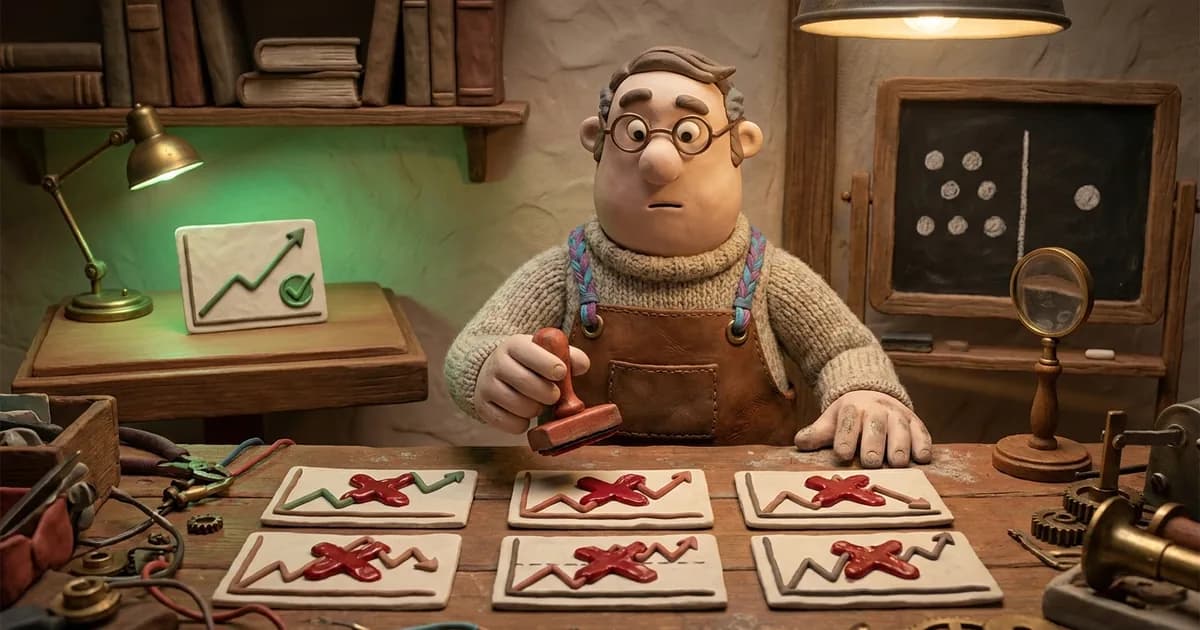
My colleague Sandra and I had a second conversation three weeks after the survivorship bias post-mortem.
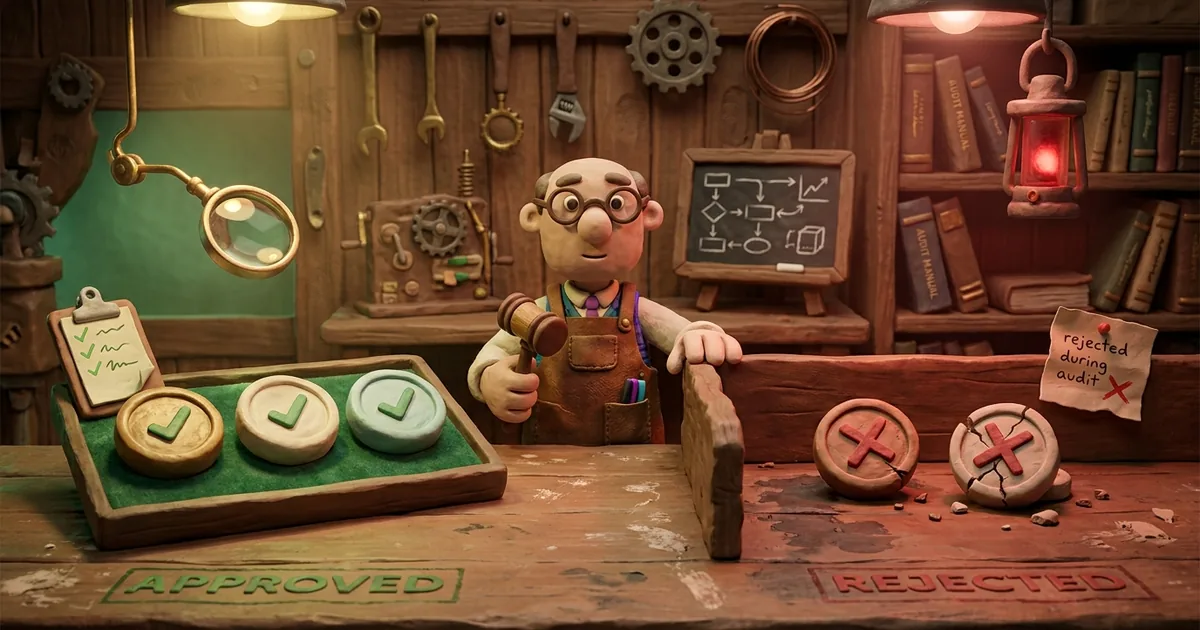
She'd read all 10 articles. Tested her portfolio against every methodology trap I'd written about. Survivorship, look-ahead, overfitting, data snooping. She rebuilt her backtest honestly. Good work.
Then she showed me her live trades for the last 18 months.
Different story.
Her entries were late. Her exits were early. She'd held three positions for over a year past her own sell signals because "they'll come back." She'd bought Bitcoin three times at local tops because her friends were making money. She'd doubled her XRP bag on a rumor, then held it through a 70% drawdown because selling would make the loss real.
Her strategy was sound. Her backtest was honest. Her trading was chaos.
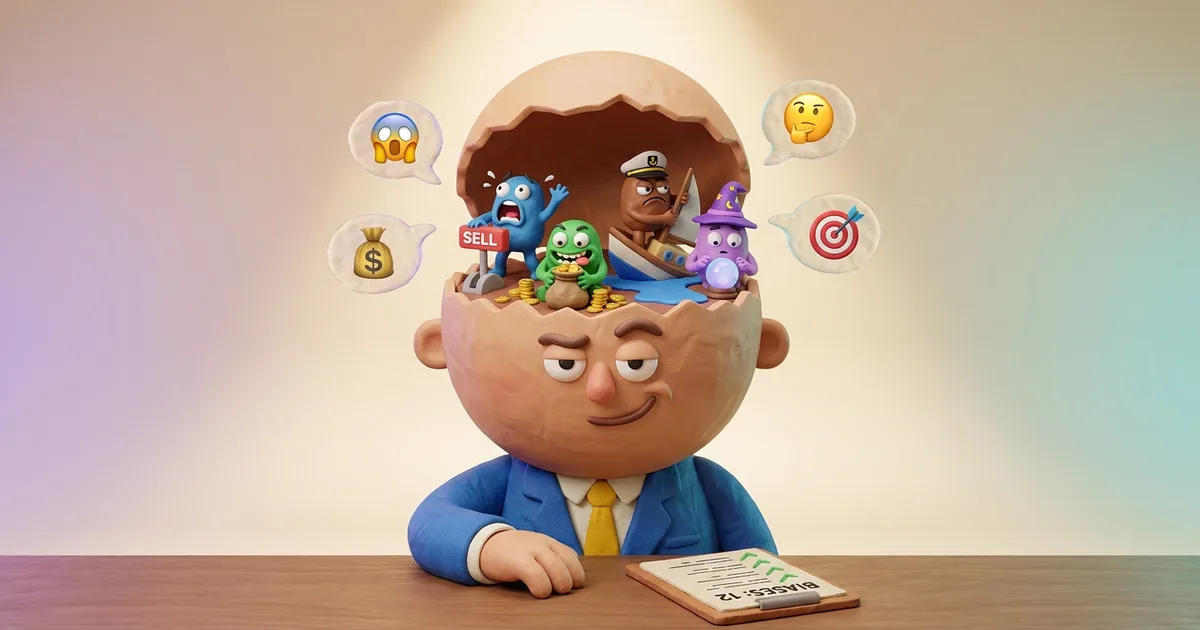
This is the second half of the story. The first 10 biases were about how your backtest lies to you (plus one meta-bias sitting under all of them — the induction problem, which applies regardless of how rigorous your methodology is). The next 12 are about how you lie to yourself, every single trade, in real time.
Our complete bias curriculum: 10 methodology biases (covered in the first pillar, numbered #1-#10) + 1 meta-bias (the induction problem, unnumbered because it applies to the entire edifice of backtesting) + 12 behavioral biases (covered below, numbered #11-#22) = 23 total biases.
These behavioral biases are worse than the methodology ones. Because they don't care how honest your backtest was. They show up when real money is on the line and real emotions are firing. And unlike backtest biases, which you can fix with better methodology, these biases live inside your head. You can't remove them. You can only learn to recognize them.
Here are the 12 that will quietly drain your portfolio if you don't.
Bias #11: Loss Aversion — Losses Hurt Twice as Much as Gains Feel Good
Kahneman and Tversky proved this in 1979. The pain of losing $100 is roughly 2x the pleasure of gaining $100. This asymmetry is hardwired. It's why you hold losers and sell winners — selling a loser makes the loss real, which is twice as painful as the pleasure of banking a winner.
Sandra sold her NVIDIA position at +8% in 2023 ("locking in gains"). She held her Peloton bag from -30% to -80% ("it'll come back"). Mathematically identical outcomes to her. Emotionally, she sold the one she felt comfortable selling.
This is the mother bias. Most of the others on this list are specific manifestations of loss aversion.
Deep dive: Why Sandra Sold Every Winner Too Early
Bias #12: FOMO — Buying at the Top Because Everyone Else Did
Fear of Missing Out. The entire 2017 ICO mania. The entire 2021 NFT bubble. The entire 2024 memecoin run. If you've ever bought Bitcoin within 48 hours of an all-time high, you've paid the FOMO tax.
The ugly part: FOMO buyers lose twice. First, they pay too much. Second, they're the ones most likely to panic-sell in the next dip. FOMO in, panic out. The complete retail tax cycle.
I paid $140,000 of this tax between 2019 and 2023. I know what I'm talking about.
Deep dive: The $140,000 FOMO Tax I Paid
Bias #13: Sunk Cost Fallacy — "I Can't Sell Now, I've Held This For 3 Years"
Economics 101: sunk costs don't matter. Your decision should only depend on future prospects. What you paid yesterday is irrelevant to whether you should hold today.
Your brain refuses to accept this. If you bought XRP at $3 and it's now $0.50, you won't sell at $0.50 even if your analysis says "this project is dead." Because selling at $0.50 means admitting you lost 83%. Holding means the loss is still "on paper" — still theoretical, still recoverable in fantasy.
I held XRP for 3 years past my own sell thesis. Cost me $140,000 (the same money I later lost to FOMO — I was a two-fer).
Deep dive: 3 Years of XRP: The Most Expensive Feelings in Crypto
Bias #14: Anchoring — Pricing Things Against Arbitrary Past Numbers
"Ethereum is cheap at $3,000 because it was $4,800 at peak."
No. Ethereum is either cheap or expensive based on its fundamentals, adoption, and forward prospects. Its past peak is informative only as evidence that market participants once valued it there. They might have been wrong.
Anchoring is why retail buyers insist "Bitcoin is a bargain at $69k" when it was $15k eighteen months earlier. And why they insist "Bitcoin is a bargain at $100k" when it was $69k twelve months earlier. The anchor is always the last peak. Never the intrinsic case.
Deep dive: $100k Bitcoin Is Cheap (Said Everyone at $69k)
Bias #15: Overconfidence — Your First 3 Winning Trades Are the Most Dangerous
You made 3 winning trades in a row. You're clearly good at this. Time to triple your position size.
No. You got lucky. In any random sequence of trades with 55% win rate, 3-in-a-row streaks happen constantly. But your brain takes "3 wins" as evidence of skill. The result: you size up just before the regression to the mean hits.
Experienced traders size DOWN after winning streaks. Amateurs size UP. The gap is everything.
Deep dive: Your First 3 Winning Trades Are the Most Dangerous
Bias #16: The Disposition Effect — Cutting Winners and Riding Losers
Specific flavor of loss aversion. Terry Odean studied 10,000 retail brokerage accounts and found a clear pattern: investors are 50% more likely to sell winners than losers on any given day. Even when the losers had worse forward prospects.
Your rationale at the moment will feel perfectly logical ("taking profits off the table," "giving it room to breathe"). The statistics are merciless. You do it too. So do I.
The only defense is mechanical: pre-set your exits before emotions arrive. Your bot doesn't panic at a loss and doesn't celebrate at a gain. That's its advantage.
Bias #17: Narrative Fallacy — Inventing Stories to Explain Random Moves
Bitcoin pumps 12% on a Saturday. Within minutes, Twitter has 500 explanations — Trump tweeted, a whale bought, technical breakout, regulatory rumor, Chinese New Year. Next weekend, Bitcoin dumps 12% on a Saturday. Same 500 explanations in reverse.
Most price moves are noise. Your brain hates noise — it craves causality. So you invent stories. Worse, you TRADE on those stories. "BTC pumped because X, so I'll buy Y."
The stories are almost never predictive. They're retrospective justifications for moves that already happened. Taleb wrote an entire book about this (Fooled By Randomness). Read it.
Bias #18: Gambler's Fallacy — "It's Been Red 5 Days, Due for a Bounce"
No. Independent events don't have memory. The next day's return is independent of the last 5. If the asset's base rate is 51% up days, it's still 51% after a 5-day losing streak.
Retail traders pump billions into "dip buying" based on this bias. The dip is not "due" for anything. It will do whatever the next period's demand/supply says it will do, regardless of how many red candles preceded it.
If anything, strong momentum in one direction tends to persist short-term — the OPPOSITE of what the gambler's fallacy suggests.
Bias #19: Self-Attribution — Wins Are Skill, Losses Are Bad Luck
Made money on a trade? Your entry was brilliant. Your research paid off. Your intuition is sharp.
Lost money on a trade? The market was manipulated. The whales coordinated. The news was unforeseeable. You were just unlucky.
Every trader does this. It's how egos survive a drawdown. The cost: you never update your priors. You never improve, because your losses don't teach you anything — they were "bad luck" so no lesson needed. And your wins give you inflated confidence for the next bet.
The fix: keep a trade journal. Write down your thesis BEFORE the trade. Compare to outcome AFTER. Honest pattern recognition kills self-attribution.
Bias #20: Representativeness Heuristic — "This Chart Looks Like 2021"
Your brain pattern-matches. Current chart has features that look like some past scenario. Therefore, it'll play out like that scenario did.
Except there are infinitely many past scenarios. Your brain selects the one that confirms what you want to do. Bull case chart looks like 2017 bull. Bear case chart looks like 2018 bear. Whatever you want, your brain can find a pattern match to justify.
Base rate of charts that "look like" 2021 and then played out like 2021: probably around 5-10%. The other 90%+ diverged sharply.
Bias #21: Status Quo Bias — "I've Always HODLed, I Always Will"
This one is sneaky because HODL often IS correct. But it's correct on its merits, not because you've "always done it." Status quo bias causes you to keep holding even when your thesis has materially changed.
If you bought BTC because "store of value, Michael Saylor was right," and then MicroStrategy collapses and Saylor recants, your thesis is broken. Do you sell? Status quo bias says no. The evidence says maybe yes.
HODL because the thesis still holds. Don't HODL because "that's what I've always done."
Bias #22: Endowment Effect — "These Are MY Bitcoin"
Behavioral economists discovered this with coffee mugs. Give people a mug, they'll demand $7 to sell it. Ask identical people what they'd pay for the same mug: $3. The ownership alone doubles the valuation.
Crypto investors do this with their bags. Your 0.8 BTC feels different than someone else's 0.8 BTC. The market doesn't care. If you wouldn't BUY BTC at $100k today, you shouldn't HOLD BTC at $100k today. The two are economically identical. Your brain insists they're different.
What You Should Actually Do About This
Three things that work.
1. Mechanical Rules, Not Discretion
Every bias on this list is triggered by making in-the-moment decisions. Mechanical rules bypass the moment.
"Sell 20% of BTC at every $20,000 increment above $100k" is a rule your bot can execute without feeling anything. The same decision made "in the moment" will always come out different because your loss aversion, FOMO, and anchoring will all fire at once.
This is the entire argument for trading bots. Not superior analysis. Superior discipline. Our 5 live bots all operate on pre-committed mechanical rules, with tier-labeled transparency so you can see exactly what they did and why.
2. Write Everything Down
A trade journal is the single highest-ROI habit you can develop.
- Thesis before entry (what do you expect to happen, and why?)
- Exit criteria before entry (what would make you sell? Price target, thesis break, time stop?)
- Outcome after exit (did the thesis play out? Did you follow your exit rules?)
After 50 trades, patterns emerge. Self-attribution dies — you see your real win rate. Narrative fallacy dies — your "reasons" don't correlate with outcomes. Sunk cost dies — your journal shows you how long you rode specific positions past your stated exit.
3. Size Small Enough to Stay Rational
The bias storm gets worse with position size. A 1% position in XRP doesn't trigger sunk cost. A 40% position does.
Most retail pain comes from positions too large to think clearly about. If you can't watch the position drop 30% without your palms sweating, it's too big. Size down until your rational brain stays in control.
The Uncomfortable Truth
You have all 12 of these biases. So do I. They don't go away with experience — they just get sneakier. Veteran traders fall for them too; they just invent more sophisticated-sounding justifications.
The only edge is awareness and structure. You can't out-think your lizard brain, but you can build systems that bypass it.
Read the deep-dives. Recognize yourself in them (you will). Then decide: keep making these decisions emotionally in real time, or let pre-committed rules — your own, or from BearBullRadar's live bots — do the hard part for you.
The 12 behavioral biases, in deep-dive order:
- Loss Aversion — The mother bias
- FOMO — Buying at the top
- Sunk Cost — Holding past the thesis
- Anchoring — Arbitrary price memory
- Overconfidence — The 3-win trap
- Disposition Effect — Cut winners, ride losers (deep-dive coming)
- Narrative Fallacy — Stories for random moves (deep-dive coming)
- Gambler's Fallacy — "Due for a bounce" (deep-dive coming)
- Self-Attribution — Wins = skill, losses = luck (deep-dive coming)
- Representativeness — "Looks like 2021" (deep-dive coming)
- Status Quo — "I've always HODLed" (deep-dive coming)
- Endowment — "These are MY coins" (deep-dive coming)
Related reading:
- The 10 Backtest Biases (methodology series) — how your tests lie
- Beat HODL or Don't Bother — the benchmark most strategies fail
- Honest trading tiers explained — what "Real Capital" vs "Paper" vs "Backtest" actually means
Not financial advice. Past performance does not guarantee future results. This article is education, not a trading recommendation.