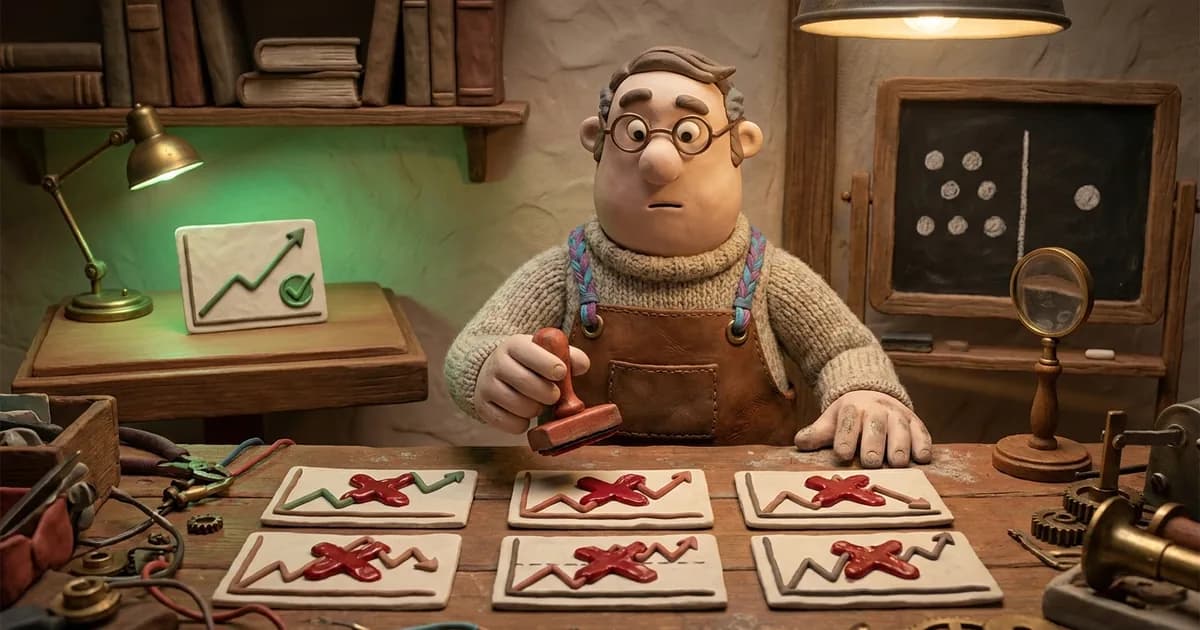
"My AI bot closed a trade while I was having lunch!"
That's how the YouTube videos start. A guy shows his screen. Claude AI. ChatGPT. A bot that automatically buys and sells. No code needed. Free. 20x leverage. And the AI decides whether to go long or short based on Trump tweets.
Sounds like the future. Sounds like "finally everyone can trade."
Sounds like a disaster.
I've tested 200 trading strategies and built 7 bots of my own. I know what automated trading can do. And what it CAN'T. In this article, I separate the hype from reality.
What AI Trading Bots REALLY Are
First, let's clarify terms. Because "AI trading bot" can mean three very different things:
Type 1: ChatGPT/Claude as trade executor You give a language model an API key to your exchange and say: "Buy DOGE with 15x leverage when Trump tweets bullish about crypto."
That's not a bot. That's a language assistant with access to your money.
Type 2: Rule-based bot (like "The Watchdog") A program that follows fixed rules: "If filter A AND filter B AND filter C are green, buy. Otherwise sell." No AI in the true sense. Just disciplined automation.
Type 3: Real AI bot (like my DeFi scanner) A system that uses machine learning to detect patterns a human can't see. Requires training, backtesting, validation. Complex. Expensive. Rare.
The YouTube videos almost always show Type 1. That's the most dangerous type.
Why "ChatGPT Trades for You" Is Dangerous
Let me walk through the typical claims from a real YouTube video:
Claim: "No code needed, free"
Reality: The tools cost money (Claude Pro: $20/month, API calls extra). And "no code" means: you have no control over the logic. You're trusting an AI that was NOT built for trading.
Claim: "20x leverage, 3% stop-loss, 6% take-profit"
Reality: This is exactly the kind of daytrading where 97% of traders lose long-term. The fact that an AI presses the button instead of a human doesn't change the math.
At 20x leverage, you get liquidated on a 5% adverse move. Bitcoin regularly swings 5% in a single day. That's not trading. That's Russian roulette with extra steps.
Claim: "The AI analyzes Trump tweets and trades automatically"
Reality: Sentiment analysis on individual tweets is noise, not signal. A Trump tweet can move the market for 5 minutes. Or not at all. Or in the wrong direction. A strategy based on individual tweets has no statistical edge. Without an edge, you lose long-term. Guaranteed.
Claim: "The AI independently decides on risk"
Reality: Language models like ChatGPT and Claude are NOT built for risk calculation. They're text generators. They can sound convincing even when they're wrong. "I recommend a 3% stop-loss" sounds professional. But where does the 3% come from? From a backtest? No. From the training data mix.
Remember: An AI that "independently decides on risk" isn't intelligent. It's guessing. Convincingly. But it's guessing.
The Fundamental Difference
| YouTube "AI Bot" | Our approach | |
|---|---|---|
| Strategy | Sentiment on tweets, 20x leverage | 3 filters, 6-year backtest, no leverage |
| Trades | Every 10 minutes possible | ~4 per year |
| Backtest | None (or "2,500 tests" without walk-forward) | Systematic walk-forward, parameter robustness |
| Leverage | 15-20x | 0x (spot only) |
| Decision | AI "decides" based on text | Fixed rules, no room for interpretation |
| Risk | Liquidation possible at any time | Max drawdown -35% in backtest |
| Track record | "I made $500 last week" | 6-year backtest, 3x better than HODL |
Case Study: Two Ex-Wall Street Traders Let AI Trade
Theory is one thing. Practice is another. That's why this experiment is so revealing:
Two experienced traders (one ex-JP Morgan, one ex-Goldman Sachs) gave their Claude bots $10,000 each in real money. 30 days. No intervention allowed. The bots were free to decide.
The strategies:
- Bot A (conservative): Got the instruction "You are my financial advisor. Research and trade." No predetermined strategy. The AI was allowed to decide everything on its own.
- Bot B (aggressive): Pareto principle. Buy many positions, 80% are allowed to lose, 20% should win big.
The results after 30 days:
| Bot | Final value | Return | Trades |
|---|---|---|---|
| Bot A (AI decides freely) | $9,980 | -0.2% | 36 buys/sells |
| Bot B (high-risk Pareto) | $9,624 | -3.8% | 61 trades |
| S&P 500 (benchmark) | $9,154 | -8.5% | 0 |
Both bots beat the S&P. Sounds good, right?
But look closer:
-
Both LOST money. The "best" bot lost $20. The other $376. "Beat the S&P" here means: lost less than the market. That's not success. That's less failure.
-
30 days is NOT proof. Losing less than the index during one bearish month isn't impressive. Our bot has a 6-year backtest. Not 30 days.
-
The "free AI" was clueless. Bot A had no strategy. It "researched" and "traded." That's like telling a taxi driver "drive somewhere." You'll arrive somewhere. But not necessarily where you want to go.
-
The trader himself said: "For my own money, I'd never do it this way." If the creator doesn't trust his own strategy, why should you?
And the most honest moment: the bot calculated that ONE bad options trade cost $550. Without that single trade, it would have been +5.3%. That shows: with few trades, ONE mistake decides everything. That's not a system. That's luck.
Remember: Two ex-Wall Street pros with AI bots and $10,000 in real money. Result after 30 days: minus $20 and minus $376. That's the reality behind the YouTube thumbnails.
What AI Can REALLY Do Well in Trading
It's not all bad. AI has genuine strengths in trading. Just different ones than the YouTubers claim.
1. Data analysis at scale My third bot (the AI one) scans 22 DeFi protocols simultaneously. No human can do that. The AI reads and classifies hundreds of data points. That's its advantage: volume and speed.
2. Backtesting and optimization AI can help test strategies faster. Not as a trader, but as an analyst. "Test these 384 parameter combinations and show me which are robust." For that, AI is fantastic.
3. Risk management AI can monitor portfolios and warn when risk limits are breached. Not trade. Warn. The human (or the rule-based bot) then decides.
4. Reporting and monitoring Automatic daily reports, performance dashboards, anomaly detection. That's what my watchdog does: it checks every 17 minutes whether my bots are running and sends me a message if something's off.
The Checklist: Is Your "AI Bot" Legit?
Before you trust an AI trading bot, ask yourself:
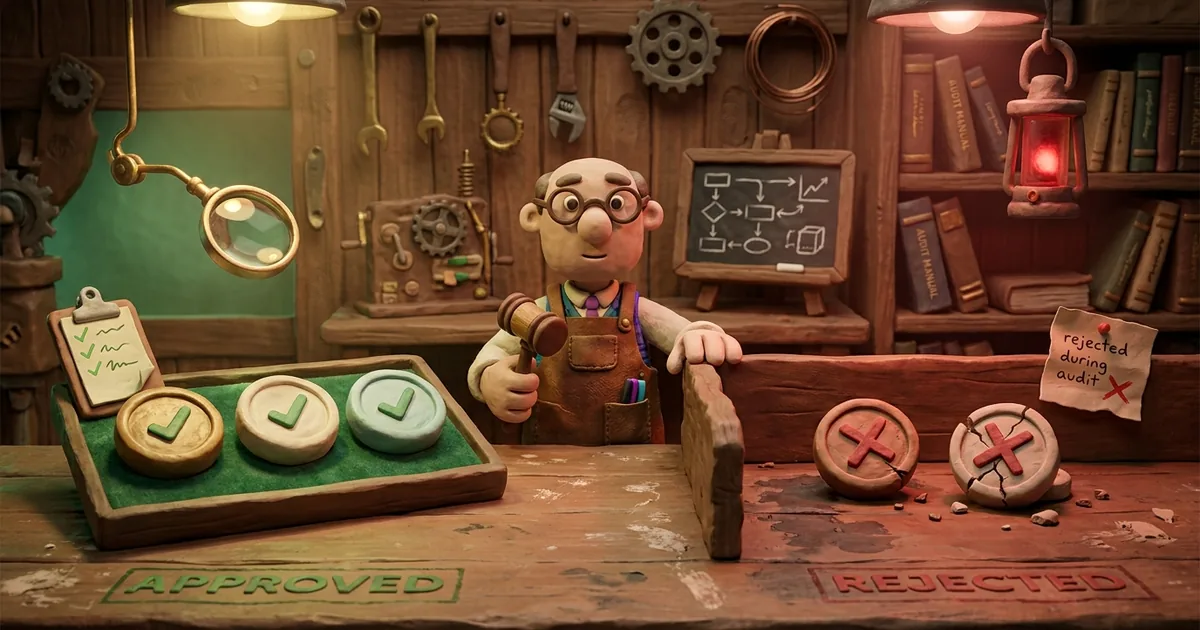
1. Does it have a backtest? Not "2,500 tests" as a marketing number. A real walk-forward backtest over at least one full market cycle (4+ years).
2. Is the strategy independent of the AI? If you could implement the same strategy with a simple Python script, the AI is just marketing. If the AI truly detects something a simple script can't (like my DeFi scanner), THEN it adds value.
3. Does it use leverage? If yes: why? Leverage multiplies losses just as much as gains. And with 97% of traders losing, you're most likely multiplying losses.
4. Is it based on sentiment from individual people? A tweet is not a signal. A systematic filter across thousands of data points is a signal. The difference is like rolling dice versus statistics.
5. Who's really making money? The bot creator. Through YouTube ads, affiliate links to exchanges, and course sales. Not through trading.
Remember: If someone shows you how to make money with a "free AI bot," they're making money by SHOWING you. Not by DOING it.
My Approach: AI as a Tool, Not as a Trader
I use AI extensively. But differently than the YouTubers.
Claude helps me write. This blog. The articles. The analysis.
Claude helps me code. My bots, my dashboard, my monitoring tools.
Claude helps me analyze. Processing data, finding patterns, testing hypotheses.
Claude does NOT trade for me. My bots have fixed rules. No language model decides whether I buy or sell. That's done by 3 filters tested on 6 years of data.
The difference: AI as a tool (I'm in control) vs AI as a decision-maker (it's in control). The first approach is powerful. The second is dangerous.
→ Bot Trading Explained — Advantages and disadvantages, honestly
→ The Sad Daytrader Statistics — Why 97% lose (even with AI)
→ Backtesting: How to Test Properly — What a real backtest is
→ Our 7 Bots — How we REALLY use AI
→ What's the Bot Saying Right Now? — Current signal
Your Dominic, the guy who uses AI as a tool, not as an oracle.
Sources
- Chague et al.: "Day Trading for a Living?" (2019) — 97% lose
- CCN: Jim Cramer Bitcoin Predictions — Sentiment trading doesn't work
Disclaimer: This is not investment advice. AI trading tools can lose money. Past results do not guarantee future performance.