28 percent.
That's the win rate of the most popular trading indicator in the world.
Less than flipping a coin. Less than guessing. Less than a monkey pressing random buttons.
The RSI (Relative Strength Index) is the first thing taught in every trading course. "Below 30? Buy!" That's what they all say.
I tested it. 58 trades. 5 years of real Bitcoin data.
The result is devastating.
Why Am I Telling You This?
Because you've probably pulled out the RSI hammer yourself at some point.
Because your YouTube guru told you that "oversold" means: "Time to buy!"
Because 9 out of 10 trading beginners think the RSI is a weather radar for the Bitcoin price.
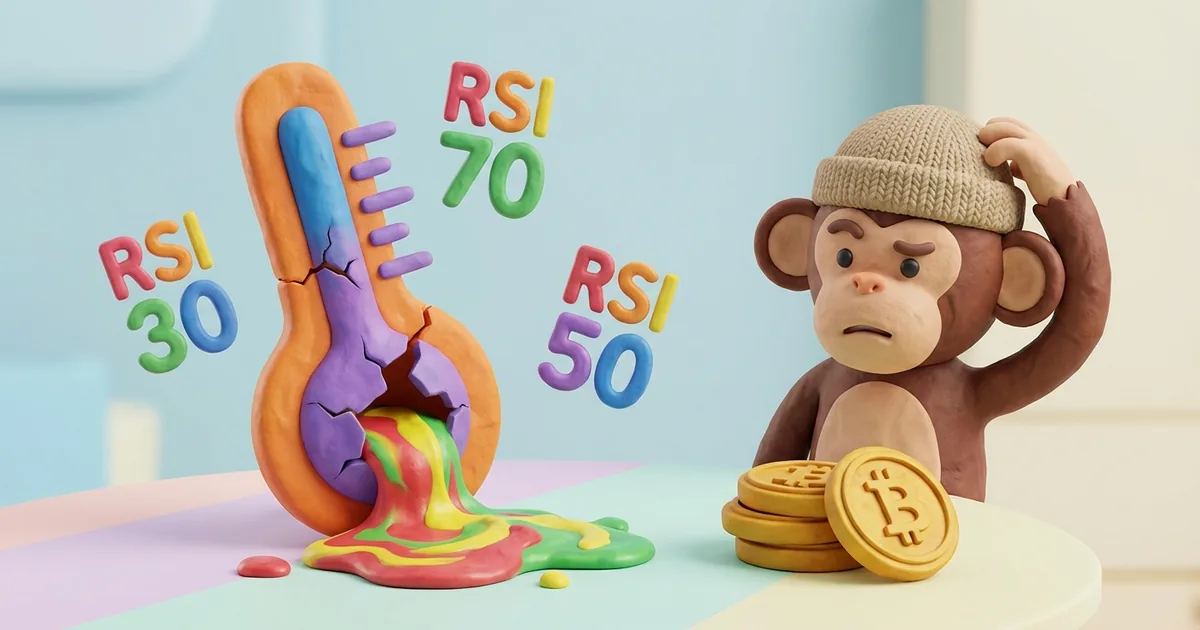
Spoiler: It's not. It's a broken thermometer measuring yesterday's temperature.
But let's look at the hard data.
Buckle up.
The Bottom Line: RSI vs. HODL
58 Bitcoin trades over 5 years. Always the same rule: buy below RSI 30, sell above RSI 70.
The result?
| Strategy | Win Rate | Performance | Max Drawdown |
|---|---|---|---|
| RSI Trading | 28% | -15.62% | -15.62% |
| HODL | 100%* | +49.20% | -84.23% |
*Win rate for HODL: 100% over 5-year holding period
You read that right. The RSI was WRONG in 72 percent of all cases. The following chart shows the difference between RSI and HODL at a glance:
While HODL made 49 percent profit despite brutal drawdown, the RSI strategy lost 15 percent.
But wait. It gets worse.
Why the RSI Is a Rearview Mirror
Imagine you're driving a car. But instead of looking forward, you tape a mirror over your eyes that only shows what's behind you.
That's how the RSI works.
It measures what already happened. 14 days of history. And from this past it's supposed to predict the future?
That's like forecasting the weather with yesterday's thermometer.
Remember: Any indicator based on historical data is a rearview mirror. It shows you where you've been, not where you're going.
"But RSI 30 means oversold!" I hear you say.
Oversold by whom? By what law must an oversold Bitcoin rise again?
Bitcoin can sit at RSI 25. Then drop to RSI 15. Then to RSI 8.
There is no rule that says: "At RSI 30, you must buy."
The only rule is: The market does whatever it wants.
Clear?
The YouTube Guru Scam
Why does every other YouTube guru still recommend the RSI?
Because it's easy.
"Buy below 30, sell above 70." Everyone understands that. You can explain it in 10 minutes. It gets clicks.
The truth is more complicated. The truth is: There's no simple rule for complex markets.
But "it's complicated" doesn't get YouTube views.
So they sell you the RSI as the holy grail.
Remember: If a trading indicator is taught in every beginner course, it's usually worthless. Otherwise all trading teachers would be rich instead of teaching teachers.
And now comes the part that'll annoy you.
What Actually Works Instead
After 200 tested strategies, I've learned one thing:
The best strategies are boring.
They don't get YouTube clicks. They don't promise 1000% in 24 hours. They don't have fancy indicators with colorful lines.
They just work.
One of them: Dollar Cost Averaging with a stop-loss at -20%.
Boring? Yes.
Works? +31.2% over the same 5 years.
Twice as good as the RSI. Half as stressful as daily trading.
Once more: The best strategy is often the most boring one.
Your Action Plan (If You Still Want to Trade)
-
Delete the RSI from your charts. Right now.
-
Ask yourself: Why do you even want to trade? Thrills? Money? Boredom?
-
Test EVERYTHING with historical data before risking real money.
-
Keep a journal of every trade. Reason, entry, exit, emotion.
-
Compare your trading performance with simple HODL.
If HODL performs better: Congratulations. You've found the best trading strategy.
It's called: Don't trade.
Easy Enough, Right?
The RSI is like a broken thermometer. Everyone uses it, but it only shows nonsense.
58 trades. 28% win rate. -15% performance.
The numbers don't lie. YouTube gurus do.
If you still want to trade: Test first, trade later. Not the other way around.
And forget the RSI. Your wallet will thank you.
Write me if you have questions. I read every email and will even test your favorite strategy on request.
-> Bollinger Bands: The Next Indicator That Fails -- Same method, same result
-> Backtesting: How to Test Strategies the RIGHT Way -- How we exposed the RSI
-> Is Your Trading Worth It? -- Calculate your expected value
-> What Does the Bot Say Right Now? -- Current signal
Your Dominic, the guy who tested 200 strategies so you don't have to.