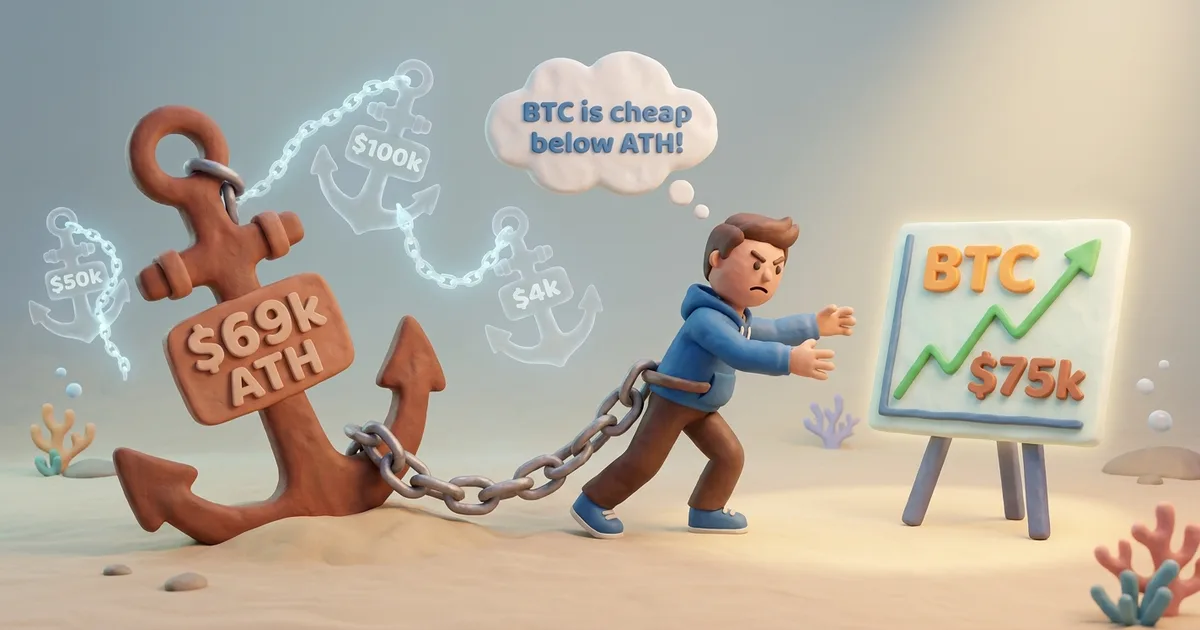
Remember when Bitcoin was "cheap at $69k"?
It was November 2021. BTC had just printed a new all-time high at $69,044. The institutional narrative was peaking. Every Twitter thread was saying "still early." Every podcast was citing "$100k by Q1 2022." $69k felt like a bargain because it was up from $4k two years earlier.
Three months later, BTC was at $35k.
By June 2022, it was $20k.
By November 2022, it was $15,800.
The people who bought at "cheap" $69k were down 77%. The people who bought at $45k, thinking they were being patient, were down 66%. The people who bought at $30k — which seemed "impossibly low" — were down 47% before the bottom.
Now it's April 2026. Bitcoin is around $75k, down from a $100k+ peak in late 2024. And everywhere I look, I see the same pattern: people saying "BTC is cheap at $75k, the last peak was $100k+."
No. BTC is not cheap at $75k. BTC is not expensive at $75k. $75k is not a reference point — it's just a price. Whether it's a good buy depends on forward prospects, not on its distance from a prior peak.
This is anchoring bias. The most pervasive, invisible, expensive bias in crypto trading. Here's how it works, why your brain does it, and how to stop paying the anchoring tax.
What Anchoring Is
Tversky and Kahneman coined the term in 1974. The classical experiment:
Researchers spun a rigged roulette wheel that landed on either 10 or 65. Then they asked subjects: "What percentage of African countries are in the UN?" Subjects who saw "10" guessed around 25%. Subjects who saw "65" guessed around 45%.
The roulette number was completely unrelated to the question. But it became an anchor — a reference point that subtly biased the final answer. Even when subjects knew the roulette was random, they couldn't shake the anchor.
Your brain does this constantly. Given any number in a decision context, it uses that number as a reference — even when the reference has no logical connection to the decision.
In crypto, the anchors are everywhere:
- The all-time high ($100k → "fair value is at least $100k")
- Your entry price ("I paid $50k, anything below is a loss")
- The round numbers ($50k, $100k, $200k feel meaningful; $47,321 doesn't)
- The recent range ("BTC was $100k last month, so $75k is a 25% discount")
None of these numbers have intrinsic meaning. They're all anchors.
The Three Anchors Eating Retail Portfolios
Anchor #1: The Previous All-Time High
This is the big one. Every bull market creates a new ATH. Then the asset retraces. Retail investors use the ATH as their "fair price" anchor for the entire next cycle.
Result: they buy 10% below the ATH thinking they got a discount. They wait for another 10% drop to "really accumulate." They never buy below 50% of ATH because "that level never happens." Then the 50% drawdown arrives and they're frozen.
Numbers from the last BTC cycle:
- ATH Nov 2021: $69,044
- Price where "still cheap" narrative died: ~$30,000 (April 2022)
- Actual bottom: $15,800 (November 2022) — 77% below ATH
- Price range where most retail capitulation happened: $20,000-$25,000
The ATH anchor prevented rational analysis. "$30k from a $69k ATH is 57% off, that must be the bottom." No — the bottom was 77% below. The ATH anchor made 57% feel like 77%-worth-of-discount feels.
Anchor #2: Your Entry Price
If you bought BTC at $50k, your brain treats $50k as the line between "winning" and "losing" for that position. Below $50k the position hurts. Above $50k it's comfortable.
Market reality: your entry price is information only about you, not about the asset. The asset doesn't know what you paid for it. Its forward return is independent of your basis.
But the anchor operates anyway. You'll:
- Sell at $51k to "break even" even if analysis says hold to $100k
- Refuse to sell at $40k because "that would be a loss" even if analysis says the position's thesis is broken
- Add at $45k not because $45k is compelling but because it "averages down" your anchor
Every one of those behaviors is anchor-driven. None of them relates to the asset's forward expected return.
Anchor #3: Round Numbers
$50,000 feels more meaningful than $49,000. $100,000 feels more meaningful than $99,000. Your brain gives round numbers a cognitive weight they don't deserve.
Every major market maker knows this. The distribution of stop-losses and take-profits clusters at round numbers. Which means the algorithms actively hunt those levels. Which means round numbers are systematically worse entry and exit points than their non-round neighbors.
If you want to sell BTC at "$100k," sell at $99,400 instead. The round number will get raided. The off-round number won't. This is a small real-money tax you pay to the anchor bias.
My Own Anchoring Story
November 2022. Bitcoin is at $15,800. FTX has collapsed the week before. My Twitter feed is dead, my Telegram groups are silent. Maximum despair.
I have cash available to deploy. My analysis says: "BTC is trading at 2.5x its realized cost basis, below the 200-week moving average for the first time in 8 years. Structurally, this is historically great buying territory."
What I actually did: nothing.
Why? Because my anchor was $69k. $15.8k felt like a 77% discount. But my brain kept telling me "what if it goes to $10k? What if it goes to $5k? You don't want to catch a falling knife."
The anchor that would have made me rational was: "What is BTC's realistic forward 3-year return from $15.8k?" (Answer: historically, post-capitulation BTC lows return 300-500% over 3 years.)
Instead, the anchor that operated was: "BTC was $69k — it shouldn't be at $15.8k — something might be broken." I paralyzed on the anchor and waited.
I eventually started buying at $22-25k during the slow recovery in early 2023. Cost me an entire 30-40% of upside relative to buying at $15.8k. That's the anchoring tax.
The Watchdog Doesn't Have Anchors
The Watchdog doesn't know what BTC was last year. It doesn't know your entry price. It doesn't think $100k is a special number. It computes one thing: is the current BTC price above or below its 100-day SMA, adjusted for Dumb Money sentiment and Liquidity Dance metrics?
That's it. No anchors. No "fair value" narrative. No "cheap vs expensive" subjective judgment. Just price, relative to its own short-term trend.
In November 2022, the Watchdog was deep in cash (DM+LD signal CASH) because the trend was broken. It started buying in early 2023 when the signal flipped back to LONG — at around $22k. Exactly when I was still frozen by the $69k anchor.
The bot had no anchor. It had a rule. The rule produced a better decision than my anchored analysis.
This is not because the Watchdog is smart. It's because anchoring bias doesn't operate on code.
How To Break The Anchor Habit
Rule 1: Compute returns forward, not backward
When evaluating an entry, ask: "What's the expected return from this price over the next 2-5 years, under realistic assumptions?"
You are NOT allowed to reference the ATH. You are NOT allowed to reference your entry. You are NOT allowed to reference round numbers. You must form an expected return estimate from scratch, with current market conditions and current fundamentals.
If the expected return beats HODL and beats cash, the buy is rational. If it doesn't, skip. The ATH is not a relevant variable in this calculation.
Rule 2: Use percentiles of the long-term distribution
Instead of "price vs ATH," think "price vs long-term range."
BTC has roughly 15 years of daily price data. On that distribution:
- P10 (cheap): bottom 10% of historical values
- P50 (median): halfway through historical range
- P90 (expensive): top 10% of historical values
$75k BTC in April 2026 is — roughly — somewhere around the P70. Not cheap, not expensive. Fair-ish. That percentile frame is useful; the "vs ATH" frame is not.
Rule 3: Blind-chart test
Hide the prices. Look at just the shape of the chart over the last 2 years. If the chart were an unnamed stock, would you want to buy it at "the current position"?
If yes, buy. If no, don't buy. If "it depends on the price," you're price-anchoring. Stop.
The decision should come from the shape, not the number. Try this on any asset where you suspect you're anchoring. If the answer changes dramatically when you see the price tag, you're anchoring.
Rule 4: Let a bot decide
Ultimately, anchoring operates on humans, not code. A mechanical strategy (RSI, momentum, moving averages, anything) doesn't know or care about the ATH.
Every one of our live bots is anchor-immune. They don't see Twitter. They don't know what BTC was last year. They check their signal and act. That's the mechanical defense — let the code do the entries, because your anchored brain won't.
The Test: Are You Anchoring Right Now?
If BTC is at $75k today, ask yourself these questions and note which one hits emotional resonance:
- "BTC at $75k is 25% off the $100k peak — that's a discount." — Anchoring to ATH.
- "BTC at $75k is above my entry of $60k — I'm up, but should I take profits?" — Anchoring to entry.
- "$75k is just below the $80k round number — let me wait for $70k for a cleaner entry." — Anchoring to round numbers.
- "BTC's expected 3-year return from $75k under base-case adoption is X%, which compares to cash at Y% and stocks at Z%." — No anchor. Rational.
If you naturally think 1, 2, or 3, you're anchoring. Welcome. So is everyone else. Now you know it.
The defense is not "try harder not to anchor." Your brain will keep doing it regardless of effort. The defense is structural rules that bypass the emotion — either rules you pre-commit to, or rules embedded in a bot that doesn't feel.
Either one beats trying to reason your way out of a bias that's baked into your cognition.
Related reading:
- Behavioral Biases Pillar — the other 11 biases
- Loss Aversion — why you then sell at a "loss"
- FOMO: The $140k Tax — anchoring's cousin at the top
- Beat HODL or Don't Bother — the benchmark that kills anchor-driven strategies
- The Watchdog — the bot with no anchors
Not financial advice. Past performance does not guarantee future results.