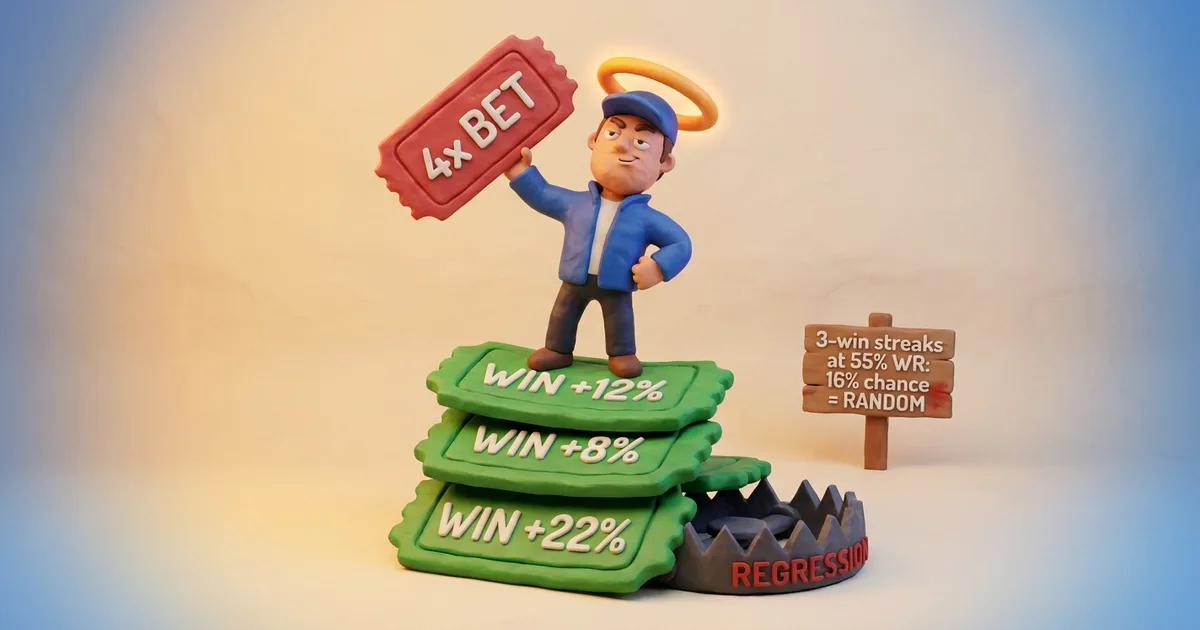
Here's a scenario. You've just closed three consecutive winning trades.
The first one: +12% on BTC, you called the dip. Lucky.
The second one: +8% on ETH, you caught a breakout. Okay, maybe a pattern.
The third one: +22% on a small cap, you sized up because you were "feeling it." Definitely a pattern. You've figured something out.
Now you're about to enter your fourth trade. Position sizing in your head has silently doubled from your original rules. You're looking at instruments you'd normally pass on. You're skipping the written pre-trade checklist because "the feel is right."
This fourth trade has a 70% chance of wiping out the gains from the first three.
Not because the fourth trade's edge is bad. Because you are now operating with miscalibrated confidence, and that miscalibration almost guarantees bad position sizing, bad entry timing, and catastrophic exit discipline.
This is overconfidence bias. And unlike loss aversion or FOMO — which feel bad — overconfidence feels great. It feels like mastery. It feels like insight. It feels like everything is falling into place.
It's also — statistically — the single most reliable precursor to blowing up a trading account. Here's why, and what to actually do about it.
The Math: Why Three Wins Prove Nothing
Suppose you have a genuine edge — a 55% win rate. You're actually a skilled trader.
In any random sequence of trades at 55% base rate:
- Probability of 3 wins in a row: 16.6%
- Probability of a 3-win streak occurring SOMEWHERE in your first 10 trades: roughly 50%
- Probability of SOME streak of 5+ wins appearing in a 50-trade sample: about 74%
Now suppose you're a below-average trader — 45% win rate, negative EV.
The same math:
- Probability of 3 wins in a row: 9.1%
- Probability of a 3-win streak in your first 10 trades: roughly 30%
- Probability of SOME 5-win streak in 50 trades: about 50%
Three wins in a row happens constantly. It happens to bad traders. It happens to good traders. It happens to random traders who literally flip coins. A 3-win streak tells you essentially nothing about your skill.
Your brain interprets it as decisive evidence of edge. The math says it's noise.
The tragedy: based on noise, you increase position size. So when the inevitable regression arrives (and it always does), the loss is disproportionately large because you sized up on noise.
This is how overconfidence converts random luck into real losses.
The Retail vs Professional Gap
This is the single clearest difference between how retail and professional traders behave:
After a winning streak:
| Retail response | Professional response | |
|---|---|---|
| Position size | Increases ("riding the streak") | Decreases or holds (regression expected) |
| Trade selection | Broadens (taking borderline setups) | Tightens (only clearest signals) |
| Risk per trade | Grows ("playing with house money") | Fixed at plan level (streak = irrelevant) |
| Emotional state | Euphoric / confident | Wary / suspicious |
Pros explicitly watch for their own winning streaks as a danger signal. They call it "rolling sevens" — when things are going too well, you know a mean reversion is statistically loading up.
Retail traders feel mean reversion emotionally after it strikes. Pros feel it before, when the streak is still running.
This asymmetry — sizing up on streaks vs sizing down — is responsible for an enormous amount of the return gap between retail and professional capital. Nothing else about skill. Just position-sizing discipline during randomness.
My Own Overconfidence Post-Mortem: ICO Mania 2017
Late summer 2017. I'd made four ICO calls in a row that all doubled within two months. Augur, Golem, 0x, OmiseGo. I was, in my own head, a visionary in emerging blockchain infrastructure.
What actually happened: I'd thrown money at 12 ICOs. Four doubled. Five stayed flat. Three lost 50-80%. My "edge" was: the overall ICO sector was moving up 5-10x in that period. Almost any portfolio caught the wave. I was not a visionary. I was exposed to a sector beta.
But I didn't know that. So I sized up for the "next round." I put $45,000 into five post-ICO tokens in September-October 2017, convinced my pattern recognition was sharpening.
Every one of those five was 80-95% lower within 18 months.
Realized losses: approximately $38,000 on that batch alone.
The first four "winners" that caused my overconfidence? I'd made about $11,000 total. So overconfidence turned an $11k gain into a $27k net loss across both batches.
The sequence matters: if I'd started with the five losers, I'd have been cautious on the next round and would never have deployed the bigger batch. The order of outcomes — random — dictated my position sizing, which dictated my outcome. Pure overconfidence bias.
The real lesson: I learned nothing about ICOs that year. I learned that a sector tailwind makes the average trade look smart. And I learned that my brain can't tell the difference between skill and beta.
The Three Overconfidence Signatures
You'll know you're in overconfidence mode when you notice any of these:
Signature 1: Your position sizes have drifted
You started with a written rule: 2% of portfolio per trade. Your last three entries were 3%, 4%, and 6%.
You didn't decide to violate the rule. You just noticed the signal was "really strong" and the size was "whatever felt right." That drift is overconfidence operating silently. Your process is being rewritten by your recent outcomes.
Signature 2: Your entries have broadened
You used to wait for your A-setups. Your last few trades were B-setups that you talked yourself into because "you're on a roll."
Trade quality and personal confidence are inversely related. You take B-trades when you feel A-quality. You take A-trades only when you feel D-quality. This is backwards from what your brain tells you.
Signature 3: You're ignoring your checklist
You used to run a pre-trade checklist. Now you're just eyeballing. "I've got the feel."
The checklist exists because disciplined humans trade better than confident humans. Skipping the checklist is a direct overconfidence tell. If you can't be bothered to check your own rules, your rules are no longer operational.
If any of these fires, the signal isn't "keep going." The signal is "reset, you're dangerous right now."
The Dunning-Kruger Crypto Special
A 1999 study by Dunning and Kruger found that the lowest-performing 25% of subjects consistently rated themselves as above-average performers. The less skill they had, the more they overestimated their own skill.
Crypto social media is Dunning-Kruger in pure form.
Spend 10 minutes on crypto Twitter. Note the difference between:
- Accounts with actual long-term track records (usually calm, often cautious, frequently share losses openly)
- Accounts with no verifiable record but huge confidence (post 100x calls daily, never publish losses, size their claims with certainty)
The second group has way more followers than the first. Confidence sells. But following them is following people who are provably overconfident — they're making claims their data can't support.
The test: when someone claims a 10x call, ask for their complete trade history for the last year. Not just the winners. All of them. Almost no one will produce it. Because almost no one has the honest history to back the confidence.
This isn't about those specific traders. It's about you using them as information sources. An overconfident source combined with your own overconfidence is a feedback loop that leads somewhere very specific: a blown-up account.
The Mechanical Fixes
Fix 1: Fixed-Fractional Position Sizing
Decide in advance: every trade risks X% of current portfolio. Non-negotiable. The rule does not care about your win streak, your mood, or your conviction.
A small version: Volatility-scaled sizing. Your position risks X% of portfolio based on the asset's recent volatility, not on your confidence.
Either one removes the primary overconfidence damage pathway (size inflation).
Fix 2: The Trade Journal That Kills Overconfidence
For every trade, log: date, size, entry, exit, P&L, and — critical — your confidence rating from 1-10 BEFORE the trade.
After 30-50 trades, run a correlation: does your confidence rating correlate with your P&L?
The honest answer for almost everyone: weak or no correlation. Your "gut feel" about trade quality doesn't predict outcomes. This is the single most humbling piece of personal data you can collect. Run it. Once you see it, overconfidence collapses permanently.
I did this myself in 2019. Ran my own trade confidence vs P&L. Correlation: 0.08 (essentially zero). My "high conviction" trades did the same as my "low conviction" trades on average. That killed the overconfidence pipeline in my head for good.
Fix 3: The Anti-Martingale Rule
After three wins in a row: reduce position size for the next two trades. Not increase. Reduce.
This feels wrong — you're sizing DOWN when things are working. But "things are working" is probably noise. Reducing size when you're hottest protects you from the regression that's statistically approaching.
Professionals use this. Retail doesn't. The difference is real money over years.
Fix 4: The Mechanical Bot Route
Our Tactician doesn't know if its last three trades won. It computes the 30-day momentum signal and acts. The prior trade's outcome is not a variable in its decision function.
That's not because the bot is calibrated better than you. It's because overconfidence doesn't exist in a mechanical rule. The rule executes the same whether the last trade was +20% or -20%.
If you can't trust yourself to size consistently after streaks, let the bot size for you. That's the honest admission most retail traders never make.
The Honest Close
You are probably going to have a winning streak this year. When it happens, you will feel like you've figured something out. You will want to size up.
Do not.
That feeling is the exact signal that should trigger more caution, not less. Overconfidence is a feature of your cognition that has been documented for 50 years. You can't out-think it. You can only pre-commit to rules that bypass it.
- Fixed size per trade
- Same checklist every time
- Trade journal with pre-trade confidence ratings
- Anti-martingale discipline after streaks
None of those are exciting. All of them work.
The traders who last longer than 5 years are not the ones who catch the biggest wins. They're the ones who don't blow up after 3-win streaks. Boring, disciplined, slightly-underwhelming execution. That's the actual edge.
Related reading:
- Behavioral Biases Pillar — all 12 biases
- Loss Aversion — overconfidence's painful sibling
- FOMO: $140k Tax — where overconfidence becomes real money
- Beat HODL or Don't Bother — the benchmark that exposes overconfidence
- Post-mortems page — the failures overconfidence produces
Not financial advice. Your mileage will vary. Past performance does not guarantee future results.